Podcast
He arrived in America as a child with no English. He was mistakenly sent to a school for juvenile delinquents. He faced rampant prejudice–yet Jensen Huang, the under-the-radar CEO of NVIDIA, became a catalyzing figure behind the AI revolution and built the most valuable company in the world. Listen as journalist Stephen Witt speaks with… MORE
 04/13/2026

 1 min
1 min
 EconLog
Much of Adam Smith’s writing in An Inquiry into the Nature and Causes of the Wealth of Nations (WN) is concrete. He explores examples of contemporary and ancient economic, political, religious, and military situations to better understand the world he lived in. As a result, his commentary touched on the economic situations of many nations.… MORE
04/13/2026
By Caleb Petitt
6 min
EconLog
Imagine that you spent 250 years being called the wrong name. That’s basically what’s happened to Adam Smith’s treatise. Everyone refers to it as “The Wealth of Nations,” and sure, that’s a reasonable shorthand for those in the know and those who are simply being expedient. But for politicians and pundits, it turns a rigorous… MORE
04/10/2026
By David Hebert
4 min
EconLog
We’re joining our friends at Liberty Matters in their celebration of the 250th anniversary of the publication of An Inquiry into the Nature and Causes of the Wealth of Nations through a series of six weekly essays. In this fifth essay, Jacob T. Levy explores one of Smith’s most famous claims in Book V of Wealth… MORE
04/08/2026
By Econlib Editors
2 min
EconLog
Today marks the 250th anniversary of the publication of Adam Smith‘s An Inquiry into the Nature and Causes of the Wealth of Nations on March 9, 1776. Wealth of Nations remains a remarkable book, not only establishing Adam Smith as “the father of economics” but laying a part of the foundation for liberal political theory. The… MORE
03/09/2026
By Janet Bufton
3 min
Article
For Smith, moral philosophy is the study of virtue and the faculty of mind that allows us to determine what is praise- or blameworthy conduct. When we understand the project of the moral sentiments, we can see that Smith adopts the same logic in his analysis of political economy. Political economy provides a lens through… MORE
04/01/2026
By Brianne Wolf
19 min
Article
Yet the argument of Book V of Wealth of Nations is something quite different. Over hundreds of pages, Smith patiently shows why both peace and a tolerable administration of justice are historically rare, and continually fragile. To the extent that some society or other happens to have them, it seems to be neither the natural… MORE
04/08/2026
By Jacob T. Levy
14 min
 EconLog
03/20/2026
7 min
 Video
Video
Nobel laureate James M. Buchanan (1919-2013) was recorded in 2001 in an extended video now available to the public. Universally respected as one of the founders of the economics of public choice, he is the author of numerous books and hundreds of articles in the areas of public finance, public choice, constitutional economics, and economic… MORE
10/16/2013
By Amy Willis
5 min
Video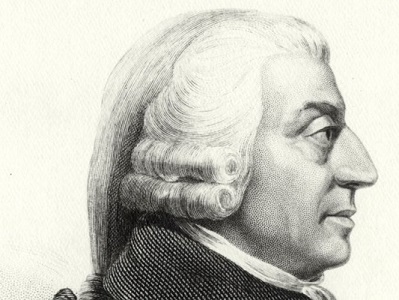
A five-part short video series on the life and contemporary relevance of Adam Smith. This video series, produced by AdamSmithWorks, can be watch as a full 38-minute feature, or in five thematic, classroom-friendly chunks. To access all, click here. Below are some discussion prompts related to this video: Part 1: The Invisible Hand… MORE
11/22/2019
5 min
Video
The twentieth century witnessed the unparalleled expansion of government power over the lives and livelihoods of individuals. Much of this was the result of two devastating world wars and totalitarian ideologies that directly challenged individual liberty and the free institutions of the open society. Other forms of expansion in the provision of social welfare and… MORE
02/25/2020
5 min
"In order to make every individual feel himself perfectly secure in the possession of every right which belongs to him, it is not only necessary that the judicial should be separated from the executive power, but that it should be rendered as much as possible independent of that power."
— Adam Smith
Biography
Douglass North shared the 1993 Nobel Prize in economics with robert fogel “for having renewed research in economic history by applying economic theory and quantitative methods in order to explain economic and institutional change.” North earned his Ph.D. in economics at the University of California at Berkeley, but by his own admission learned how… MORE
02/05/2018
3 min
Biography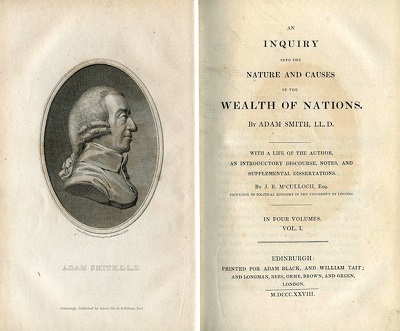
With The Wealth of Nations Adam Smith installed himself as the leading expositor of economic thought. Currents of Adam Smith run through the works published by David Ricardo and Karl Marx in the nineteenth century, and by John Maynard Keynes and Milton Friedman in the twentieth. Adam Smith was born in a small village… MORE
02/05/2018
13 min
 Encyclopedia
For more than two centuries economists have steadfastly promoted free trade among nations as the best trade policy. Despite this intellectual barrage, many “practical” men and women continue to view the case for free trade skeptically, as an abstract argument made by ivory tower economists with, at most, one foot on terra firma. These practical… MORE
02/05/2018
By Alan S. Blinder
10 min