
Studies in the Theory of International Trade
By Jacob Viner
In this book I first endeavor to trace, in a series of studies of the contemporary source-material, the evolution of the modern “orthodox” theory of international trade, from its beginnings in the revolt against English mercantilism in the seventeenth and eighteenth centuries, through the English currency and tariff controversies of the nineteenth century, to its present-day form. I then proceed to a detailed examination of current controversies in the technical literature centering about important propositions of the classical and neo-classical economists relating to the theory of the mechanism of international trade and the theory of gain from trade. The annual flow of literature in this field has become so great in the last few years, and the claims on my time and energy from other unfortunately unavoidable activities of a quite divergent sort have been so heavy, that the completion of this book and the rendering of full justice to the recent literature have proved to be incompatible objectives. I hereby present my sincere apologies to the substantial number of economists who have in recent years made valuable contributions to the theory of international trade which are here either wholly neglected or treated more summarily than they deserve…. [From the Preface]
First Pub. Date
1937
Publisher
New York: Harper and Brothers Publishers
Pub. Date
1937
Copyright
The text of this edition is under copyright. Picture of Jacob Viner courtesy of the University of Chicago Department of Economics.
Chapter VIII
GAINS FROM TRADE: THE DOCTRINE OF COMPARATIVE COSTS
It is always to be remembered that the failure of an argument in favor of a proposition does not, generally speaking, add much, if any probability, to the contradictory proposition.
—Jevons,
Principles of Science.
I. THE NATURE AND ORIGIN OF THE DOCTRINE
The classical theory of international trade was formulated primarily with a view to its providing guidance on questions of national policy, and although it included considerable descriptive analysis of economic process, the selection of phenomena to be scrutinized and problems to be examined was almost always made with reference to current issues of public interest. This was true even of the classical discussions of the mechanism of international trade, but it was more conspicuously true in the field which is sometimes called “the theory of international value,” where the problems were expressly treated with reference to their bearing on “gain” or “loss” to England, or on the distribution of gain as between England and the rest of the world. Recognition of its “welfare analysis” orientation is essential to the understanding and the appraisal of the classical doctrine. Although the classical economists did not clearly separate them, and shifted freely from one to the other, they followed three different methods of dealing with the question of “gain” from trade: (1) the doctrine of comparative costs, under which economy in cost of obtaining a given income was the criterion of gain; (2) increase in income as a criterion of gain; and (3) terms of trade as an index of the international division and the trend of gain. This chapter will deal with the doctrine of comparative costs.
The doctrine of comparative costs originated as an improvement and development of the eighteenth-century criticism of mercantilist policy, and it has continued to command attention mainly
because of its use as the basic “scientific” argument of free-trade economists in their attack on protective tariffs. Protectionists have an obvious motive for attacking the doctrine, but it has also been rejected by economists whose animus seems to arise from the fact that it was one of the outstanding products of the English classical school, by economists who deal with it as an exercise in pure price theory and as such find it unsatisfactory, and by economists who believe that they have at their command a superior technique than it affords for the appraisal of commercial policy. Never widely accepted on the Continent, the doctrine now is clearly on the defensive everywhere.
The doctrine of comparative costs maintains that if trade is left free each country
in the long run tends to specialize in the production of and to export those commodities in whose production it enjoys a comparative advantage in terms of real costs, and to obtain by importation those commodities which could be produced at home only at a comparative disadvantage in terms of real costs, and that such specialization is to the mutual advantage of the countries participating in it. In the exposition of the doctrine the “real” costs are expressed as a rule in terms of quantities of labor-time, but with the implication, as throughout the classical theory of value, that these quantities of labor-time correspond in their relative amounts within each country to quantities of subjective cost. The legitimacy of this assumption that labor-time costs are proportional to real costs is examined at length later in this chapter, and for the present will not be questioned.
There has been some measure of confusion as to the nature of the comparisons between costs which the doctrine contemplates. According to Cairnes:
…when it is said that international trade depends on a difference in the comparative, not in the absolute, cost of producing commodities, the costs compared, it must be carefully noted, are the costs in each country of the commodities which are the subjects of exchange, not the different costs of the same commodity in the exchanging countries.
*1
But it is not costs at all which are directly to be compared, but
ratios between costs, and it is unessential whether the cost ratios which are compared are the ratios between the costs of
producing different commodities within the same countries or the ratios between the costs of producing the same commodities in different countries.
| Commodity | Real costs per unit
|
|
| Country A | Country B | |
| A… | m | r |
| B… | n | s |
| C… | p | t |
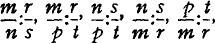
In the illustration given above, it does not matter whether the ratios compared are
 , and
, and
 , on the one hand, or
m:r, n:s, and
p:t, on the other hand. In the first set of comparisons, country A has its greatest comparative advantage in the production of that commodity whose cost in A appears as the numerator in the first term of the lowest of these ratios, and its greatest comparative disadvantage in the production of that commodity whose cost in A appears as the denominator in the first term of the lowest of these ratios. In the second set, country A has its greatest comparative advantage in the production of that commodity whose cost in A appears as the first term in the smallest of these ratios, and its greatest comparative disadvantage in the production of that commodity whose cost in A appears as the first term in the highest of these ratios. Whatever numerical values are assigned to the unit real costs, both these methods of comparison will necessarily produce identical results, though the first method will ordinarily be found much more convenient to use. If the first method is used, the units used in the measurement of cost need not be identical or even comparable in the two countries. It is then not necessary, for instance, to know whether
m is greater or less than
r, or whether
n is greater or less than
s.
In the beginnings of free-trade doctrine in the eighteenth century the usual economic arguments for free trade were based on the advantage to a country of importing, in exchange for native products, those commodities which either could not be produced
at home at all or could be produced at home only at costs absolutely greater than those at which they could be produced abroad. Under free trade, it was argued or implied, all products, abstracting from transporation costs, would be produced in those countries where their real costs, were lowest. The case for free trade as presented by Adam Smith did not advance beyond this point.
In an earlier chapter, however, it has been shown that several writers prior to Adam Smith, and especially the author of
Considerations on the East-India Trade, 1701, stated the case for free trade in terms of a rule which would provide the same limits for profitable trade as does the doctrine of comparative costs, the rule, namely, that it pays to import commodities from abroad whenever they can be obtained in exchange for exports at a smaller real cost than their production at home would entail. Such gain from trade is always possible when, and is only possible if, there are comparative differences in costs between the countries concerned. The doctrine of comparative costs is, indeed, but a statement of some of the implications of this rule, and adds nothing to it as a guide for policy.
*2
Many of the classical economists, both before and after the formulation of the doctrine of comparative costs, resorted to this eighteenth-century rule as a test of the existence of gain from trade. Ricardo incorporated it in his formulation of the doctrine of comparative costs:
Though she [i.e., Portugal] could make the cloth with the labor of 90 men, she would import it from a country where it required the labor of 100 men to produce it, because it would be advantageous to her rather to employ her capital in the production of wine, for which she would obtain more cloth from England, than she could produce by diverting a portion of her capital from the cultivation of vines to the manufacture of cloth.
*3
Malthus had credited as a factor contributing to the prosperity of the United States her ability to sell “raw produce, obtained with little labor, for European commodities which have cost much labor.”
*4 To this, Ricardo replied:
It can be of no consequence to America, whether the commodities she obtains in return for her own, cost Europeans much, or little labor; all she is interested in, is that they shall cost her less labor by purchasing them than by manufacturing them herself.
*5
This explicit statement that imports could be profitable even though the commodity imported could be produced at less cost at home than abroad was, it seems to me, the sole addition of consequence which the doctrine of comparative costs made to the eighteenth-century rule. Its chief service was to correct the previously prevalent error that under free trade all commodities would necessarily tend to be produced in the locations where their real costs of production were lowest.
In his
Principles, first published in 1817, Ricardo presented the doctrine of comparative costs by means of what was to become a famous illustration, in which the quantity of wine which required for its production in England the labor of 120 men could be produced in Portugal by 80 men, while the cloth which in England required the labor of 100 men could be produced in Portugal by 90 men. Portugal would then import cloth from England in exchange for wine, even though the imported cloth could be produced in Portugal with less labor than in England.
*6
Credit for the first publication of the principle of comparative costs is generally given to Ricardo. Leser,
*7 however, in 1881, assigned to Torrens the credit of discovery of the doctrine on the
strength of the following passage in Torrens’s
Essay on the External Corn Trade, 1815:
If England should have acquired such a degree of skill in manufactures, that, with any given portion of her capital, she could prepare a quantity of cloth, for which the Polish cultivator would give a greater quantity of corn than she could, with the same portion of capital, raise from her own soil, then tracts of her territory, though they should be equal, nay, even though they should be superior, to the lands in Poland, will be neglected; and a part of her supply of corn will be imported from that country. For, though the capital employed in cultivating at home might bring an excess of profit over the capital employed in cultivating abroad, yet, under the supposition, the capital which should be employed in manufacturing would obtain a still greater excess of profit; and this greater excess of profit would determine the direction of our industry.
*8
Leser’s comment attracted no notice, but some years later credit for priority in formulating the doctrine of comparative cost was again claimed for Torrens, this time by Professor Seligman.
*9 Professor Hollander has replied, in defense of Ricardo’s claims, that much of the evidence in support of Torrens presented by Seligman was not relevant or was of questionable weight; that even after the appearance of Ricardo’s
Principles Torrens never realized the full significance of the comparative cost doctrine and never made explicit use of it; and that Ricardo’s claims to priority could not be overcome merely by the fact that Torrens, in a single paragraph, had correctly stated the doctrine “in outline” before Ricardo had published his
Principles.*10
Torrens clearly preceded Ricardo in publishing a fairly satisfactory formulation of the doctrine. It is unquestionable, however, that Ricardo is entitled to the credit for first giving due emphasis to the doctrine, for first placing it in an appropriate setting, and for obtaining general acceptance of it by economists. Hollander, moreover, appears to be justified in his contention that
the doctrine was never an integral part of Torrens’s thinking. While Torrens again stated the doctrine, and stated it very well, in at least two of his publications,
*11 and incidentally first used the term “comparative cost” in connection with the doctrine,
*12 these later statements are frankly presented as improvements on Torrens’s earlier views resulting from the discussion of the problem by other economists. Torrens’s grasp of the doctrine, moreover, was not so firm that he could not occasionally display confusion about its meaning and implications.
*13
Much of the evidence from Torrens’s writings which Seligman cites to demonstrate that he was an exponent of the doctrine of comparative costs shows only, as Hollander says, that Torrens accepted the argument that international division of labor was beneficial, or that he accepted the principle that it paid to import commodities if they could thus be obtained at lower cost than the cost of producing them at home, a principle which I have shown above to have had its origin early in the eighteenth century.
The only claim to priority over Ricardo with reference to the doctrine of comparative costs which Torrens made
*14 was based on the passage in the 1815 edition of the
Essay already cited above. Hollander surmises that even this earlier passage itself may owe something to discussion of the question with Ricardo, but until it is at least made clear that Torrens and Ricardo were already acquainted in 1815, not much weight is to be attached to
this possibility. On the other hand, Torrens’s own claim to priority should not be given too great emphasis, since Torrens was erratic both in his claims and in his acknowledgments, and could be abundantly quoted against himself.
*15
Ricardo’s illustration implies a number of important assumptions which, in conformity with his usual practice, he never expressly states. His conclusions have been criticized both on the ground that they do not follow from his assumptions, and on the ground that the assumptions necessary for the validity of his conclusions are unrealistic and that with their abandonment or correction the conclusions would cease to hold. It is more or less obvious that Ricardo based his analysis on the following assumptions: ample time for long-run adjustments; free competition; only two countries and only two commodities; constant labor costs as output is varied; and proportionality of both aggregate real costs and supply prices within each country to labor-time costs within that country. Those criticisms or corrections of Ricardo’s analysis which do not involve a rejection of his assumptions will be examined first, and the more fundamental criticisms which question the validity of his assumptions will be dealt with later.
II. THE DIVISION OF THE GAIN FROM TRADE
An Alleged Error in Ricardo.
Ricardo has been charged with claiming, on the one hand, that all the gain from trade goes to one of the countries
*16 and, on the other hand, that all the gain goes to
each country,
*17 instead of finding it to be divided between the two countries.
The data given in Ricardo’s arithmetical illustration are as follows:
| Country | Amount of labor required for producing a unit of
|
|
| Cloth | Wine | |
| Portugal… | 90 | 80 |
| England… | 100 | 120 |
In order that all the benefit from trade should go to England, English cloth must exchange for Portuguese wine in the ratio of I unit cloth for 9/8 unit wine. In order that all the benefit should go to Portugal, English cloth must exchange for Portuguese wine in the ratio of i unit cloth for 5/6 unit wine. But Ricardo states that English cloth will exchange for Portuguese wine in the ratio of I cloth for I wine: “Thus England would give the produce of the labor of 100 men [= 1 cloth] for the produce of the labor of 80 [= 1 wine].”
*18 At this ratio, the gain would be divided approximately evenly between the two countries. Ricardo, therefore, was guilty of neither error attributed to him.
James Mill, in the first edition of his
Elements of political economy, did commit the error of attributing all the gain to each of the countries, but he corrected it in the third edition, 1826.
*19 Einaudi at one time attributed the error to Ricardo as well as to James Mill, and on the strength of a suggestion of Torrens’s raised the question whether it was not James Pennington who first perceived and corrected the error.
*20 Sraffa,
*21 in reply, pointed out that Ricardo had not been guilty of the error, and
that J. S. Mill, in his
Autobiography,*22 had stated that his father made the corrections in the 1826 edition of his
Elements as the result of criticisms made by himself and by George Graham in 1825.
Another co-worker of J. S. Mill’s, William Ellis,
*23 early in the same year, 1825, had presented an arithmetical illustration similar to those used by James Mill, and had concluded therefrom that the gain would be equally divided between the two countries. It seems, therefore, that the error was detected about the same time by several members of the group associated with James Mill.
Relation of Comparative Costs to the Terms of Trade
In Ricardo’s illustration, the two commodities exchange for each other under trade in a ratio almost exactly halfway between their comparative cost ratios in the two countries.
*24 Ricardo does not indicate whether he regards this precise ratio as required by the conditions of the problem as he had stated them, or how the actual ratio would in practice be determined. Ellis in 1825 and James Mill in 1826 also stated that the gains from trade would be equally divided between the two countries. McCulloch presented the doctrine of comparative costs in terms of an arithmetical illustration under which the ratio of gain was equal for both countries.
*25 It is doubtful whether these writers attached any special significance to these arbitrary
*26 terms of trade, since in the early writings of the classical school, and especially in the works of Longfield and Torrens, recognition can be found of the fact that the location of the equilibrium terms of trade was variable and depended on the relative strength of the demand of
the two countries for each other’s products. Pennington, however, seems to have been the first explicitly to point out in print that the comparative costs set maximum and minimum rates for the terms of trade, and that within these limits the operation of reciprocal demand could fix the terms of trade at any point.
*27
Torrens had long been insisting vigorously that the terms of trade were determined by reciprocal demand, and his emphasis on this in connection with the tariff controversy in the 1840’s
*28 had aroused considerable opposition on the part of economists who found Torrens’s application of it as an argument against unilateral reduction of tariffs distasteful. The interest aroused by Torrens’s discussion led J. S. Mill to publish in 1844 some essays written in 1829 and 1830, of which one dealt with the same problem. It was from his exposition in the
Essays,*29 repeated and developed later in the
Principles,*30 and not from Longfield, Torrens, or Pennington, that later economists took over the doctrine. No country would give in exchange for a unit of a foreign commodity A more units of a commodity B than it could produce at a real cost equal to that at which a unit of A could be produced at home. The comparative costs set the limits, therefore, within which the two commodities could exchange for each other, but the actual ratio is set by the reciprocal demand of the two countries for each other’s products. The greater the demand for B in terms of A in the country with a comparative advantage in the production of A, the closer, other things being equal, would the rate of exchange of A for B approach to their relative costs of production in that country. The greater the demand for A in terms of B in the country with a comparative advantage in the production of B, the closer, other things being equal, would the rate of exchange of A for B approach to their relative costs of production in this other country. Under equilibrium conditions,
however, the value of the exports must equal the value of the imports. Of the possible ratios of exchange between A and B, that one would be the actual ratio which made it possible to meet this condition, i.e., that ratio at which the quantity of A offered by one country would equal the quantity of A which the other country would be willing to take.
Trade at One of the Limiting Ratios.
Nicholson later pointed out, with the aid of a series of arithmetical illustrations, that if there were only two countries and two commodities, and if the relative magnitudes of the two countries were not the same, the terms of trade would probably settle at or near the comparative costs of the larger country, i.e., the smaller country would get all or nearly all the gain from trade. He suggested that the omission of consideration of the relative size of the two countries had resulted in some measure of confusion in J. S. Mill’s analysis.
*31 Graham has more recently repeated this argument, although without reference to Nicholson. Graham has carried the argument further by pointing out explicitly that approximate equality in importance of the commodities as well as of the countries was necessary if under the conditions stated each country was to get a substantial share of the benefits from trade.
*32 Graham asserts, on the basis of this argument, that the situation which to J. S. Mill was only an “extreme and barely conceivable case,” namely, that all the benefit should go to one of the countries, was, under the conditions of constant costs, only two countries, and only two commodities, rather the normal case. He agrees with J. S. Mill that division of the benefit is the normal case, but only because ordinarily more than two commodities enter into trade, so that when the terms of trade are moving against a country because of excessive export of one commodity, it begins to export other commodities in which its comparative advantage is less, and thus checks the adverse movement of its terms of trade. He concedes, however, that Bastable has recognized these probabilities in trade between a small and a large country, but criticizes his manner of dealing with the problem.
*33
Graham’s reasoning is sound, but his criticism of J. S. Mill is
only partially justified. The passages in Mill’s
Principles which he attacks are quotations, presented as such, from Mill’s
Essays written long before. In the same chapter of the
Principles in which these quotations appear, in a section first added in the third edition (1852), Mill explicitly raises the same problem, and gives the same answer as does Graham. He asks why, in a particular illustration given by him, he should assume that trade would result in the benefit being divided instead of all of it going to one of the countries. He answers that in such a case the country which gets all the benefit from trade would probably find it to its advantage to import from the other country additional commodities in which that other country had a comparative advantage, although a lesser one than in its original export commodity, in exchange for additional quantities of its own export commodity, until a state was reached where the other country no longer produced any of the commodity which it imported and the terms of trade had become such as to divide the benefit between the two countries. “And so with every other case which can be supposed.”
*34 Pennington had already, in 1840, pointed out that the entrance of more commodities and more countries into trade would tend to prevent the terms of trade from establishing themselves at a point at which all of the gain goes to one of the countries.
*35
The Possibility of Partial Specialization.
Graham
*36 cites as another error in Mill’s analysis, the following passage:
Cost of carriage has one effect more. But for it, every commodity would (if trade be supposed free) be either regularly imported or regularly exported. A country would make nothing for itself which it did not also make for other countries.
*37
Graham shows that if trade is at one of the limiting ratios this is erroneous even on the assumption of constant costs, since a country which trades on terms corresponding to its own relative costs of production may be, and is likely to be, producing at home some portion of its consumption of the commodity which it imports. It seems clear, however, that while Mill at first held that
complete specialization would necessarily follow from free trade in the absence of transportation costs, he later adhered to it only on the assumption that trade did not take place at one of the limiting ratios, when the proposition would be correct. In correcting, in the third edition of his
Principles, his earlier doctrine that with trade in only two commodities the terms of trade would ordinarily be such as to divide the benefit between the two countries, he also corrected this error. In the case which he assumes of trade at one of the limiting ratios, he makes one of the countries specialize only partially in the commodity which it exports. If Germany had a comparative advantage in linen and England in cloth, and if at the ratio of exchange equal to their relative costs of production in Germany the latter was willing to take more cloth than England could supply, then if no third commodity entered into the trade “England would supply Germany with cloth up to the extent of a million” and “Germany would continue to supply herself with the remaining 200,000 by home production.”
*38 Whewell had previously shown, on the basis of Mill’s own illustrations, that on the assumptions of constant costs, only two commodities, and only two countries, one of the countries was likely to find itself in a position where it derived no gain from trade, and that such country might specialize only partially in the production of the commodity in which it had a comparative advantage.
*39
Graham points out that Bastable also asserted the impossibility of only partial specialization under conditions of constant costs, only two countries, and only two commodities.
*40 Here again, however, he has not read his author carefully enough. In dealing with what he calls the “special case” of trade between a small and a large country Bastable had clearly, although inconsistently with his general denial, asserted the possibility—as far as the context indicates, perhaps even the probability—that the larger country will only partially specialize in the production of the
commodity in which it has a comparative advantage.
*41 In 1897, moreover, Edgeworth criticized Bastable’s position, and showed that Mangoldt had long before demonstrated the possibility of partial specialization by one of the countries,
*42 and in an appendix added in the third edition Bastable conceded his error.
*43
Ricardo had supported his argument for the benefit of international specialization in accordance with comparative costs by the following analogy with trade between two persons:
*44
Two men can both make shoes and hats, and one is superior to the other in both employments; but in making hats, he can only exceed his competitor by one-fifth or 20 per cent—and in making shoes he can excel him by one-third or 33 per cent;—will it not be for the interest of both, that the superior man should employ himself exclusively in making shoes, and the inferior man in making hats?
Pareto, citing this passage from Ricardo, argued that it was erroneous in its implication that
complete specialization would necessarily be advantageous, as compared to no specialization at all. He showed by means of arithmetical illustrations that complete specialization would under some circumstances result in more of one commodity but less of the other, as compared to no specialization, and that, depending on the relative demands for these commodities, the increase in one commodity might not be sufficient to offset in value the deficit in the other commodity.
*45 This has occasionally been interpreted as a partial rejection of the principle of comparative costs as an argument for free trade.
*46If it were so intended, it could, of course, easily be refuted by showing that specialization in accordance with comparative costs, to the extent that such specialization would tend to be carried under free trade, would not, under the conditions stated, result in a loss. But it seems an injustice to Pareto to interpret him in this way. His criticism appears to be directed only against the proposition that
complete specialization is necessarily profitable as compared to no specialization. Pareto himself shows that where complete specialization would not be profitable it would not take place even under free trade.
*47
Ricardo’s statement that it would be to the interest of two
individuals to specialize completely if each had a comparative advantage in the production of one of the commodities seems an inadequate basis, moreover, upon which to convict him of the belief that complete specialization would necessarily be profitable to each of two
countries if they had comparative differences in costs of production. It so happens that the sentence cited by Pareto to show that Ricardo held this belief follows immediately in Ricardo’s text an express stipulation that partial specialization by one of the countries is a possibility:
It will appear, then, that a country possessing very considerable advantages in machinery and skill, and which may therefore be enabled to manufacture commodities with much less labor than her neighbors, may, in return for such commodities, import
a portion of the corn required for its consumption, even if its land were more fertile, and corn could be grown with less labor than in the country from which it was imported.
*48
Another writer, A. F. Burns, later repeated Pareto’s demonstration
that complete specialization may be unprofitable.
*49 This writer goes further, however, than did Pareto, for he definitely argues as if specialization along the lines of comparative advantage necessarily involves complete specialization, and then claims that whenever such specialization results in more of one commodity but less of another it is impossible to show that free trade has been profitable. He overlooks the fact that if the specialization is voluntary it will not be carried to the point where the marginal unit exported is worth less on the market than what is obtained in exchange for it, and, therefore, that while there may be no profit from trade for one of the countries under the conditions stated, there must be profit for at least one of the countries, and there can be loss to neither, if in each country the prices of its own products are proportional to their real costs.
III. TRADE IN MORE THAN TWO COMMODITIES
The problems connected with the doctrine of comparative costs have usually been examined under the simplifying assumptions that there are only two commodities and only two countries, in the belief that while the introduction of more commodities or countries into the problem would complicate the analysis it would require no serious qualitative change in the conclusions reached on the basis of the simple assumptions as to the nature and profitability of international specialization.
*50 This position seems to me substantially correct, although certain problems relating to foreign trade tend to be neglected when these assumptions are followed.
Graham has, however, put forth the claim that because of its adherence to the assumptions of only two countries and only two commodities, “the classical theory of international values seems…to be open to grave objections, objections which, while they do not subvert its foundations, nevertheless call for a substantial
modification of its conclusions,”
*51 and in a later article
*52 he has expressed his criticism in still stronger terms. Some of his criticisms are well taken, and expose genuine weaknesses in the classical expositions of the theory. As Graham explains, however, his objections are mainly directed against the reciprocal-demand theorizing of J. S. Mill and Marshall, and not against the doctrine of comparative costs, which is alone the concern of this chapter. The classical economists, moreover, departed from the rigid assumption of only two commodities more often than Graham would lead one to suppose. Several instances, in which analysis in terms of more than two countries bore on the relationship between comparative costs and terms of trade, are examined below.
Longfield appears to have been the first to attempt to extend the Ricardian analysis so as to deal explicitly with more than two commodities. Where there are only two commodities, then, given the comparative costs, there is no question as to which commodity each country will respectively import and export. But when there are more than two commodities the question as to what commodities will be exported and what imported by each of the countries cannot be so readily answered. Longfield’s solution, although not entirely satisfactory, approached closely to what later became the accepted one. He abstracts from transportation costs, and from all elements in real costs but labor costs, and assumes tacitly that when trade is under way all prices will be identical in the two countries. He then assumes tentatively that wages in each country are uniform in all occupations. He offers, apparently without realizing it, several different and inconsistent solutions. He first asserts that wages in the two countries will be proportional to the
average productivities of labor in the two countries. If English labor, presumably before trade, is on the average three times as productive as French labor, and therefore English money wages three times as high as French wages, then in all those industries in which English labor is, say, four times as productive as French labor money costs will be comparatively low, and these commodities will be exported; while in those industries in which English labor is not more than twice as productive as French
labor, money costs will be comparatively high, and these commodities will be imported. “Commerce will flow according as the proportion [of labor productivity] in particular trades is below or above the average proportion.”
*53
Later he argues that if, while England was exporting the product of industries in which her labor was twice as productive as that of foreign countries, she acquired a threefold superiority in some other new industries, then her greater superiority in the new industries would make the old ones unprofitable. Labor in the old industries would have to be paid at the same rate as in the new, or at three times the rate prevailing abroad, and as its productivity in the old industries was only twice that of foreign labor, foreigners could produce the old products more cheaply in terms of money costs.
*54
Still later he provides a slightly different solution:
…if a nation enjoyed an immense superiority in the production of two or three articles of very general demand, the wages of her laborers might be, in consequence, so high that she could not compete with the rest of the world in any other manufacture, under a system of free trade. Let us suppose the productiveness of English labor to be ten times as great as that of any other nation, in the production of tin, calico, coals, cutlery, and pottery. The wages of her laborers will, in consequence, be much greater than those in any other nation; suppose them eight times as great, and suppose that English labor is only twice as productive as foreign labor, in the manufacture of other commodities. These latter, therefore, will be fabricated in the rest of the world, at the fourth part of the price which it will cost to make them in England.
*55
Longfield here presented correctly two important elements of the correct solution, namely, that for each country the commodities exported would be in the upper and the commodities imported would be in the lower range of its potential products with respect to comparative advantage in real costs, and that comparative money wage rates in the two countries would determine the precise line of division between export and import commodities. Where he failed, however, was in not providing a satisfactory explanation of the mode of determination of the ratio between
wages in the two countries. His first two solutions are both obviously arbitrary and incorrect. Wages in the two countries would be proportional neither to the average productivities in all pretrade employments, nor to the productivities in the two countries in the relatively most productive employment of
one of the countries. His final formula, where he makes the wage rate in England exceed the wage rate abroad by a somewhat smaller ratio than the ratio of superiority of English labor over foreign in those employments in which England is comparatively most efficient, is correct as far as it goes, but is insufficient basis for a definite solution of the problem. This was an important step forward, but Longfield’s contribution unfortunately attracted no attention, and other leading writers did not deal at all with the problem of what determines the relative level of money incomes in different countries or accepted an unsatisfactory solution offered by Senior.
Senior argued that within any country the level of money wages in all occupations—proper allowance being made for differences in the attractiveness of different occupations—was determined by the wages which labor could earn in the export industries, and that the comparative levels of wages in the export industries of different countries were determined by the comparative prices which the export products of the different countries could command in the world markets.
*56 This became standard doctrine, although it left unanswered the question, given more than two commodities, as to how it was determined what would be the export industries. The prevailing level of wages would obviously be a factor in determining which industries could find export markets for their products. But to explain the determination of which industries should be export industries by reference to the general wage level, and to explain the general level of wages by reference to the level of wages prevailing in the export industries, would obviously be reasoning in a circle. Senior’s argument sufficed to show that under equilibrium conditions wages in the non-export industries must be equal to wages in the export industries and that wages in different countries must be proportional to the value productivities of labor in the export industries of the respective countries. Senior failed to show, however, that
wages in the non-export industries were determined by wages in the export industries instead of both sets of wages being the common product of a number of factors.
In the writings of Ricardo and the two Mills no approach to a solution of this problem is to be found. Torrens, in an elaborate discussion bearing evidence of indebtedness to Senior and Long-field, made some progress. He pointed out that the extent to which a country could confine its exports to the commodities in whose production it was at or near the upper limit of its scale of comparative advantage depended on the extent of the foreign demand for these commodities. The wider the range of commodities which it had to export in order to employ its labor to the best advantage, the lower, other things equal, would be its relative level of money wages as compared to other countries.
*57 Cairnes also attacked the problem, and reached the correct conclusion that while the general level of wages and foreign trade were intimately connected, the connection was one not of simple cause and effect operating in a single direction, but of joint dependence on the “productiveness of industry” as a whole and on the demands for different commodities.
*58 He left vague, however, the precise nature of the inter-relationships between productivities, wage levels, and international specialization.
A minor writer, P. J. Stirling, attempted to deal with the problem,
*59 but did not carry it as far as had Longfield. He claimed that the two countries would find it to their interest to exchange at each other’s “par,” or on terms proportional to the cost of production of the exchanged commodities. “The terms of the exchange are regulated by the relative efficiency of the labor of the two countries in the production, not of all commodities, but of those commodities in the production of which their efficiency is most nearly equal.” He thus assimilated the theory of international value to the theory of domestic value, completely where there is some product whose cost is identical in the two countries,
and approximately where there is no such product. He presented the following case:
| 1,000 days labor will produce in | |
| England | Mexico |
| 50 iron | 50 iron |
| 25 tin | 400 silver |
| 50 wheat | 100 wheat |
| 150 cloth | 75 cloth |
Tin and silver are commodities peculiar to England and Mexico, respectively, and iron has identical costs in both countries. England will export cloth and import wheat, in the ratio of 150 units cloth to 100 units wheat, or the reciprocal of the ratio of their costs of production in the countries where they can be respectively produced at a comparative advantage. Although he does not expressly say so, silver and tin will also presumably exchange in the reciprocal of the ratio of their costs of production, or 400 units silver for 25 units tin, and iron will not move in trade. He says that if the English output of iron should increase to 55 units per 1000 days labor, other things remaining the same, then the rate at which English cloth would exchange for Mexican wheat would be 150 units cloth for 110 units wheat, which, it will be noted, makes the double factoral terms of trade with respect to these two commodities conform to the reciprocal of the ratio between the costs in the two countries of the commodity, iron, in which these costs approach most closely to equality. This is of course a purely arbitrary solution. But it has at least the one point of merit that it posits that the commodities which each country will export and import, respectively, will lie in the upper and the lower range of its series in terms of comparative advantage.
The necessary further step toward a satisfactory solution was taken by Mangoldt.
*60 He shows that, cost of production being regarded as constant, each country will specialize in the production of a group of one or more commodities, that the commodities within each of these groups will exchange for each other in proportion to their real costs of production, and that the terms on which the commodities belonging to the two different groups will exchange for each other will be determined by the effect of
the reciprocal demand of the two countries for each other’s export commodities on the relative money rates of remuneration of the productive factors in the two countries. To find a basis for determining which country will export any particular commodity. Mangoldt posits the existence of a commodity such that, when its real costs in each of the respective countries are multiplied by the rates of remuneration prevailing there, there will result a money cost which is equal in both countries. Mangoldt presents his argument by means of laborious arithmetical illustrations, but it seems preferable to expound it with the aid of Edgeworth’s ingenious logarithmic illustration, which, among other advantages, dispenses with the necessity of positing a commodity which is just on the margin of export or import.
Let the two columns of letters on either side of the vertical line in chart VIII (a) represent the logarithms of the real costs of the commodities a, b, c, d, e, in the two countries, with the left-hand column representing costs in country I and the right hand column representing costs in country II. Locate the points
a, b, c, d, e by marking off from a fixed point
o the logarithms
of the real costs of the respective commodities in country I. Assume that the right-hand column can be made to slide freely up and down while the left-hand column is held rigid. From any fixed point
o‘ on this sliding column mark off in the same way and on the same scale as for country I the points
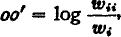
a’, b’, c’, d’, e’, representing the logarithms of the real costs of the respective commodities in country II. Slide the right-hand column up or down to make
oo‘ equal the logarithm of the ratio of wages in country II, (
wi), to wages in country I, (
wii), so that
putting
o’ below
o when wages in country II are lower than wages in country I, as in Chart VIII(a), and putting
o’ above
o when wages in country II are higher than wages in country I, as in chart VIII(b).
*61 The relative rates of wages in the two countries, and therefore the distance of
o‘ below or above
o, will be determined by the reciprocal demand of the two countries for each other’s products, which in turn will be partially determined by the comparative costs. Real costs in the two countries remaining the same, any shift in their reciprocal demand for each other’s products would result in a change in relative wages in the two countries and therefore in a corresponding shift, upward or downward, in the movable right-hand column in chart VIII(a). If the demand of country I for country II’s products in terms of its own products increased, other things remaining the same, the right-hand column in VIII(a) would slide upward, and vice versa. The vertical distances from
o, when the right-hand column is adjusted properly, of the points
a, a’, b, b’, etc., will then show the logarithms of the money costs of production of the different commodities in the two countries in terms of a common currency unit.

Since the reciprocal demands are not shown in this chart, it does not show how the comparative wage rates are determined. It shows, however, given the real costs in each country and the comparative wages as determined by reciprocal demand, what commodities each country will export and import, respectively,
and on what terms. If the wage rates are as indicated in chart VIII (a), the money costs of production will be higher in country I for commodities a, b, and c, and lower in country I for commodities d and e, then in country II. Country I will therefore export d and e, and import a, b, and c. The commodity terms of trade as between each pair of export and import commodities will be indicated by their comparative prices: e.g., the number of units of commodity a obtained by country I in return for 1 unit of d will be
 the number of units of b obtained by country I in return for one unit of e will be
 and so forth. If there were a commodity with equal money costs of production in both countries, that commodity might be exported or imported by either country, might not move at all in foreign trade, or might be exported from one country to the other while being produced in both countries, quite consistently in each case with the conditions stated.
Whatever commodities country I will export and whatever ones she will import, the ratio of the logarithms of the real costs, and therefore also the ratio of the real costs in country I to the real costs in country II, will be lower for each of the commodities exported by country I than for any of the commodities imported by country I. Thus in (a) of the above chart, where country I exports commodities d and e and imports commodities a, b, and c,
 and
and
 are both smaller than
 or
or
 *62 But as Edgeworth points out:
*63
This theory brings into view an incident which is apt to be masked as long as we confine ourselves to the case of two commodities,…namely, that it is not in general possible to determine
a priori, from a mere observation of the [real] costs of production in the respective countries before the opening of the trade, which commodities will be imported and which produced at home…. Thus if
o‘ in the figure be pushed up a little, the distances
o’a’, o’b’ etc., being preserved constant,
e will become an export (from country no. I) instead of an import. But the position of
o‘ depends not only the cost of production in each country, but also on the law of demand in each country for the different commodities.
This can perhaps be more clearly brought out by a comparison of (a) and (b). The scales of comparative costs are the same in both (a) and (b), but because of different reciprocal demands in the two cases the ratio between wages in country I and wages in country II is higher for (a) than for (b). As a result, country I exports only commodities d and e in case (a), as compared to commodities, b, c, d, and e in case (b).
IV. TRADE BETWEEN MORE THAN TWO COUNTRIES
The older writers rarely departed from the simplifying assumption that only two countries participated in foreign trade, and there are therefore only a few instances to be examined of discussion of the problems of international trade in terms of more than two countries.
William Ellis, in an attempt to meet the argument current in his time that England would suffer injury if competition with her staple export industries should develop abroad, introduced for the first time a third country into arithmetical illustrations of the type used by Ricardo and James Mill in their exposition of the doctrine of comparative costs.
*64 He began with England and France engaged in trade, with England having a comparative advantage in cottons and France in silk. He then showed that the entrance into the trade of a third country, Brazil, with a comparative advantage in sugar, did not result in a loss to England. This, of course, did not meet the issue, and to have made his point he would have had to show that England could not lose from the entrance of Brazil into trade even if Brazil’s comparative advantage was in the same commodity, cotton, as England’s.
*65
In his only reference to a third country, J. S. Mill first considered the effect on the terms of trade of England with Germany of the entrance into trade of a third country exporting the same commodity as Germany, namely, linen, and concluded that in consequence England would get her linen more cheaply in terms of English cloth. He then assumed that the third country produces neither linen nor any other commodity in demand in England, but has a demand for English cloth, and produces commodities which are in demand in Germany, and concluded that here also England’s terms of trade with Germany would improve as the result of the entrance of the third country into trade, as Germany would have to induce England to take more of her linen in order to obtain the means of paying for her imports from the third country.
*66 This seems to me to be correct reasoning as far as it goes. But there are other possibilities, unfavorable for England, which Mill left unmentioned, as, for instance, if this third country had no demand for English cloth but was herself a potential exporter of cloth and importer of German linen.
Torrens, in
The Budget, had argued that if Cuba imposed a duty on English cloth, the restoration of equilibrium in the trade balance of the two countries would require a relative fall in the price of English cloth as compared to Cuban sugar. Merivale replied that if an alternative source for sugar was available to England, although at a somewhat higher price than that at which Cuban sugar was available before the imposition of the Cuban duty on cloth, the rise in the price of Cuban sugar and the fall in the price of English cloth “would soon bring into play the competition of the next cheapest country producing the same commodities as Cuba.” While the Cuban duty, therefore, would affect adversely the terms of trade of England, the injury to her would
be much less than if Cuba were the only source of sugar.
*67 Torrens, in reply, criticized some of the details of Merivale’s argument, but conceded that on Merivale’s assumption that sugar could be obtained from other sources at a price not much higher than the Cuban price prior to the imposition of the Cuban duty on English cloth, the terms of trade would not shift seriously against England.
*68
Cairnes claimed that, while if there were only two countries with wide differences in their comparative costs of producing the staple articles of trade there would be a very considerable range within which the terms of trade could be determined under the influence of comparative costs, if there were more countries competition from one or more of these countries would prevent the terms of trade from settling at either of the limiting rates.
*69 This is valid as a probability, but Cairnes proceeded to too rigorous a conclusion:
…it is not the difference in the comparative costs of production in each pair of trading countries that fixes the limits to the possible variations of international values under the influence of reciprocal demand, but, among all countries mutually accessible for commercial intercourse, the difference of comparative costs, as it exists in the particular countries in which that difference is least. The limits of variation are thus set by the minimum, not by the maximum, difference in comparative cost among the various exchanging and competing countries.
*70
There is no such necessity. Assume the following situation:
| Commodity | |||
| Units of real cost per unit of product
|
|||
| Country I | Country II | Country III | |
| M… | 1 | 2 | 3 |
| N… | 2 | 1 | 1 |
If at the ratio of three of N for one of M country III is willing to supply all of commodity N which all three countries want, then this will be the effective rate of exchange of the two commodities, and trade between country I and country III will take place on terms corresponding to the “maximum difference in comparative cost among the various exchanging and competing countries.”
Triangular (or multiangular) trade has been examined by Graham,
*71 Taussig,
*72 von Mering,
*73 and earlier writers,
*74 by means of arithmetical examples of one type or another. Edgeworth’s logarithmic illustration, modified so as to apply to more than
two countries, seems to me, however, to be better suited to the purpose than arithmetical illustrations.

Chart IX is constructed on the same principles as chart VIII, except that four countries are included, instead of only two. What commodities each country will export and import and on what terms will be determined by the comparative costs in conjunction with the comparative wage rates, and the latter in turn will be determined, in part, by the reciprocal demands. For chart IX (a), the following situation will prevail under equilibrium conditions:
| Country | I | II | III | IV |
| Exports… | A | C | B | D |
| Imports… | C,D | A,B,D,E | A,C,D,E | A,B,C |
In addition, country I may either export or import or not trade in commodities B and E, and country IV may either import or export or not trade in commodity E, these commodities being on the margin of trade for those countries. The ratios in which the commodities will exchange for each other will, of course, be the reciprocals of their price ratios in a common currency. Their prices will be the antilogs of the logarithms of lowest money costs represented by the vertical distances from O
1 on a right line, as indicated below:
| Commodity | A | B | C | D | E |
| Price = antilog of… | O2A1 | O1B2 | O2C3 | O1D4 | O2E4 |
In IX, (b) all the real costs are the same as in (a), but because the reciprocal demands are different in (b) from what they are in (a), money costs, prices, and the conditions of trade are also different, as compared to (a). Under equilibrium conditions, the following situation will prevail in (b):
| Country | I | II | III | IV |
| Exports… | A | C | B | D,E |
| Imports… | B,C,D,E | B,D,E | A,C,D,E | A,B,C |
In addition, country II may either import, export, or not trade in commodity A, this commodity being on the margin of trade for that country. The prices of the commodities will be as follows, measured as before by the antilogs of the indicated vertical distances:
| Commodity | A | B | C | D | E |
| Price=antilog of… | O1A1 | O 1B3 |
O1C2 | O1D4 | O1E4 |
For country I, the change in the demand situation from (a) to (b) improves its terms of trade with the outside world, i.e., enables it to get B,C,D, and E in greater quantities per unit of its export A, or per unit of real cost, than before.
V. TRANSPORTATION COSTS
The theory of international trade is usually expounded on the assumption that there are no transportation costs, and this has occasionally been made a basis of criticism. But abstraction from transportation costs is also a common feature of the exposition of the theory of trade in a single market—”closed economy”—and such abstraction does not apear to be logically less permissible in the one case than in the other. Notwithstanding, moreover, the common assumption that transportation costs are relatively much more important in foreign than in domestic trade, it is by no means clear that such is the general situation. Cases are common where internal freight costs from producer to consumer are higher than international freight costs from producer to consumer, as can be seen from a study of the transportation item in the reports on costs of production in different countries made by the United States Tariff Commission.
*75 The role of transportation costs, both of products and of factors of production, in contributing
to regional differences of prices is an important field for study. It has not, however, been historically the particular responsibility of the theory of international trade, and judging what has so far been done in this field, under the name of
Standortslehre, it is not yet apparent, in spite of the claims of its exponents,
*76 that the indebtedness will be by the theory of international trade to
Standortslehre rather than the other way round.
The relation of transportation costs to production costs and the terms of trade can be illustrated by chart X, a slight modification
of Marshall’s graphic method of dealing with foreign-trade problems. In country A a given amount of labor can produce either one unit of copper or one unit of wheat, and in country B a given amount of labor can produce either 3/2 units copper or ½ unit wheat. Country A will export wheat, and country B will export copper. In the absence of transportation costs, wheat will exchange for copper on terms within the limits of 1 wheat = 1 copper ( =
OA in chart) and 1 wheat = 3 copper ( =
OB = 3 ×
OA, in chart).
AA’ represents the export supply curve of wheat in terms of copper of country A.
BB’ represents the import demand curve of wheat in terms of copper of country B. The chart as drawn implies that in the absence of trade (or with trade on terms of 1 wheat = 1 copper) country A would consume (
OA ×
AE) units of copper, and that in the absence of trade (or with trade on terms of 1 wheat = 3 copper) country B would consume
BF wheat.

The actual transportation is assumed to be provided by the exporter. The charges for transportation are assumed to be 1 unit wheat payable in the export country for each 9 units of wheat transported and 1 unit copper payable in the export country for each 5 units of copper transported. With the transportation costs in the specified amounts, the possible limits of the terms of trade will be 1 wheat = 1.2 or
Oa copper and 1 wheat = 2.7 or
Ob copper. Country A’s export supply curve for wheat in terms of copper will be
aa’, and country B’s import demand curve for wheat in terms of copper will be
bb’. The equilibrium terms of trade, which would have been 1 wheat =
OK copper in the absence of transportation costs, will be 1 wheat =
mr copper, net after payment of transportation costs, for country A, and 1 wheat =
ml copper, net after payment of transportation costs, for country B. It is to be noted that with the existence of transportation costs the terms of trade net after payment of transportation costs will be different for the two countries, the difference being absorbed in meeting the costs of transportation. Given elasticities greater than unity for both the foreign-trade curves, volume of trade will be smaller and the net terms of trade will be less favorable for both countries when there are transportation costs than when these are zero. In the present case the existence of transportation costs will reduce the amount of wheat imported by country B from
OH to
Om units, and will reduce the amount of copper imported by
country A from (
OH ×
OK) units to (
Om ×
Or) units.
*77 The division of the costs of transportation as between the two countries will, as J. S. Mill contended, be determined by “the play of international demand.”
*78
VI. INCREASING AND DECREASING COSTS
Ricardo, in his statement of the doctrine of comparative costs, assumed that costs of production were constant as output was varied, and this assumption has been followed, explicitly or implicitly, in much of the later literature, and in this chapter so far. Where costs are constant no issue arises as between average and marginal costs, since these are identical. If costs to the individual producer increase as output is increased, the doctrine of comparative costs still holds, but must be stated in terms of comparative marginal costs.
If there are no external economies or diseconomies of large production, pecuniary or technological, i.e., if a producer who keeps his own output constant experiences no change in costs as the result of a change in the output of his industry as a whole, then either in an isolated country or under free trade labor will tend to be distributed among the respective industries until, at equilibrium, its marginal value return
to the industry as a whole per unit of labor is equal in all industries. Assuming only two commodities and two countries and labor as the only factor of production, abstracting as usual from transportation costs, and assuming that before trade country A has a comparative advantage in marginal cost in the production of commodity M, it will be to the advantage of country A under trade to transfer its labor from the production of N to the production of M until the point is reached where its comparative marginal cost advantage ceases.
*79 Under constant cost, there is an apparent
*80 gain from trade, measured in saving in cost on the imported commodity, even on the marginal unit of trade, unless the terms of trade correspond to the relative costs of production of the country in question, when there is no gain for that country from any part of the trade. But under increasing costs, the saving in costs is confined to the infra-marginal units of trade.
*81
Under constant costs, a country will not both import and produce
for itself any commodity unless the price relations between that and other commodities produced in that country correspond to their relative costs of production in that country, i.e., unless that country is deriving no benefit from the import of that particular commodity. This does not hold true, however, for commodities produced under conditions of increasing costs, when simultaneous importation and domestic production of a commodity indicate that all (except the marginal unit) of the imports are obtained at lower real costs than those at which they could be produced at home. Under increasing costs, both (all) commodities can conceivably be produced simultaneously under equilibrium conditions in both (all) countries. When trade is carried to the equilibrium point under increasing costs, i.e., to the point where each country is fully exploiting the possible gains from trade, the ratios of marginal real costs as between the two (all) countries will be the same for all commodities being simultaneously produced in both (all) of these countries, and it will be the comparative differences in the marginal costs which would result if the existing trade were altered in volume or direction, rather than any prevailing difference in actual marginal costs, which would explain the existing trade.
It should be apparent that charts such as charts VIII and IX above, which were constructed on the assumption of constant costs, would not be applicable to illustrate the problem of international specialization where increasing costs are operative. Since the marginal costs in each industry and country would vary with the output, there would not be a single and fixed scale of costs for the different commodities in each country. If, as was likely, the rate of increase of marginal costs as output increased differed from commodity to commodity, and differed for the same commodity from country to country, there would be no fixed order of rank of the commodities in terms of comparative marginal costs for each country, as their ranks would tend to change with substantial changes in the outputs of the respective commodities. As has already been pointed out, under equilibrium conditions specialization would be carried to the stage where the relative scales of marginal costs would be uniform for all the countries producing the respective commodities.
Schüller has made an elaborate critique of free trade which rests in large part on considerations which must be regarded as
essentially short run in character or as inconsistent with free competition, and therefore as outside the scope of the present discussion.
*82 Such, for instance, is his argument that factors of production which are displaced from their original employment by foreign competition ordinarily fail in substantial degree to find alternative employment. His argument also that commercial policy may either attract productive resources from abroad or induce them to emigrate, and that the former is desirable and the latter undesirable, whatever its validity—and his argument is exceedingly one-sided, since if the injury to one industry from free trade in its product tends to drive its factors out of the country, the benefit to other industries and to consumers should in like manner tend to induce immigration and check emigration of the factors not engaged in this industry—is also outside the scope of this article. But an essential portion of his case is made to rest on the existence of a wide range between the money costs at which different producers within an industry can produce their output. In the long run, and even in the short run under free competition, there must necessarily be a tendency for equality of marginal money costs for all producers in a given industry, and it is these marginal costs, and not the average costs which Schüller alone considers, which are the regulator of value. None of his inferences unfavorable to free trade as a long-run policy which depend for their validity on the simultaneous existence of different costs for different producers therefore has any force.
*83
It has frequently been claimed by economists that if a country has a comparative advantage in costs in an industry or industries subject to increasing costs as output is increased and has a comparative disadvantage in an industry or industries subject to decreasing costs, it may not be to the interest of this country to specialize in accordance with comparative costs. All of the attempts which have been made to demonstrate this proposition follow the same general line of argument. It will be conceded beforehand that there is a trace of validity in this proposition,
but a very faint one, long-run considerations alone being understood to be relevant.
In the long run, specialization in accordance with
marginal cost to the industry or country must be to the advantage of a country, in so far as costs are made the criterion of advantage. If a country is at a comparative advantage in marginal costs in an industry subject to increasing costs, the transfer of a marginal unit of the productive factors from the decreasing-cost to the increasing-cost industry must necessarily yield to that country a greater increment of whichever commodity it prefers to have than this marginal unit of the productive factors would yield if left in the decreasing-cost industry. Let the country with the comparative advantage in the increasing-cost industry be designated by M, the increasing-cost product by a, and the decreasing cost product by b. At the given stage of specialization in this country, let 1/X
a be the marginal cost per unit of a in terms of units of the productive factors, and let 1/X
b be the marginal cost of b. Then
XaXb will be, respectively, the number of units of a and of b produced at the margin by one unit of the productive factors. Suppose further that at the given stage of specialization in M,
Xa units of a can be exchanged in foreign trade for
Y units of b. Since by hypothesis M still has a comparative marginal advantage in the production of a, then
Y >
Xb, and by using the marginal unit of the factors of production to produce a rather than b, M gains either
Y –
Xb units of b, if what it wants is more units of b, or
 units of a, if what it wants is more units of a. In either case, M gains by further specialization in the production of a. The only basis on which specialization under these conditions of marginal cost might be unprofitable to M would be if specialization and trade were not governed by industry marginal costs.
All of the many attempts to demonstrate the possibility that specialization in accordance with comparative costs by a country with a comparative cost advantage in increasing-cost industries and a comparative cost disadvantage in decreasing-cost industries may be unprofitable for it have much in common, and only three of the more elaborate ones will be examined here, and only one
in detail.
*84 Nicholson makes such an attempt,
*85 which is open to other criticism, but which can be disposed of on the ground that his analysis is not completely in marginal-cost and marginal-return terms. He posits the case of a country with a comparative advantage in the production of wheat subject to increasing costs and a comparative disadvantage in manufacturing subject to decreasing costs. As the result of the opening of trade, manufacturing becomes unprofitable, and the factors are shifted to wheat-growing, manufactures being imported in exchange for wheat. There results for the country, in an extreme case, no increase in the amount of wheat available for consumption and a decrease in manufactures. Nicholson bases his conclusions on marginal-cost analysis as far as wheat is concerned, but on average-cost analysis for manufacturing. Had he applied marginal-cost analysis to both, he could not have obtained results of this kind.
Francis Walker obtains similar results by means of arithmetical computations in terms of money income from charts showing monetary-demand and average-cost curves before and after trade.
*86 His procedure is defective in almost every conceivable particular. He at no point carries his analysis to a stage consistent with long-run equilibrium. He fails to provide for full employment of all the factors both before and after trade. He keeps all of his analysis on a superficial monetary level, and makes no attempt to allow for changes in the significance of the monetary unit as the result of trade, even though he includes “consumers surpluses” measured in money in his computations. His results are totally devoid of significance.
Graham
*87 also obtains similar results by a method of analysis not differing in any essential from that used by Nicholson, although he makes no reference to him. Graham, however, sets forth his argument in much greater detail, with less ambiguity in use of terms, and with at least passing reference to the objections
which might be raised against his reasoning on value-theory grounds. He supports his argument with arithmetical illustrations, which will be reproduced here with modifications which do no violence to the original but facilitate their appraisal.
| Case I. Incipient Specialization: *88 |
4 wheat = 3½ watches |
| Country A | Country B |
| (200) | (200) |
| 1 day’s labor = 4 wheat | 1 day’s labor = 4 wheat |
| (200) | (200) |
| 1 day’s labor = 4 watches | 1 day’s labor = 3 watches |
The comparative advantage of country A is in watches and of country B in wheat, and in so far as comparative costs alone are concerned trade may take place between the two countries on any terms within the limits of 4 wheat = 3 watches and 4 wheat = 4 watches. The actual ratio is assumed to be 4 wheat = 3½ watches and when trade is initiated a small amount of trade takes place at that ratio, country A exporting watches and importing wheat. Both countries appear to gain from the trade, country A getting 4 wheat at a cost in labor with which she could produce only 3½ wheat at home, and country B getting 3½ watches at a cost in labor with which she could produce only 3 watches at home.
| Case II. Intermediate Specialization: | 4 wheat = 3½ watches |
| Country A | Country B |
| (100) | (300) |
| 1 day’s labor = 4.5 wheat | 1 day’s labor = 3.5 wheat |
| (300) | (100) |
| 1 day’s labor = 4.5 watches | 1 day’s labor = 2 watches |
Trade is carried further, on the same terms of exchange of wheat for watches, country B increasing her specialization in the production of wheat and country A in the production of watches. But in both countries the production of wheat is subject to increasing costs and the production of watches to decreasing costs. Each unit of trade still seems to yield gain to both the participants, since country A gets each 4 units of wheat at a
labor cost at which she could only produce 3½ wheat at home, and country B gets 3½ watches at a labor cost at which she could produce only 2 2/7 watches at home. But country B is really losing from the trade, since as she increases her total output of wheat and decreases her total output of watches, the productivity of labor falls in both industries. If in case I the total trade consisted of an exchange of 4 wheat for 3.5 watches and in case II the total trade consisted of an exchange of 320 wheat for 280 watches, then in case I country B would have as its total income 796 wheat + 603.5 watches, and in case II only 730 wheat + 480 watches.
This is as far as Graham goes with his illustrations, but if the argument is sound, and if it is assumed—and there is no reason why it should not be—that the indicated trends of cost as output is varied continue to operate, they can be, and must be, carried still further, with rather spectacular results.
| Case III. Full Specialization: | 4 wheat = 3.5 watches |
| Country A | Country B |
| (1) | (399) |
| 1 day’s labor = 5 wheat | 1 day’s labor = ½ wheat |
| (399) | (1) |
| 1 day’s labor = 5 watches | 1 day’s labor = ¼ watch |
Except for 1 unit of labor, each country is now completely specialized in the employment in which it is at a comparative advantage. But it is profitable to the participants in trade to carry specialization to the fullest extent possible, for if the day’s labor still engaged in producing watches in country B were to be diverted to growing wheat, it could with the ½ unit wheat so obtained secure in exchange 7/16 of a watch, instead of only the ¼ watch which it can produce directly. Country B has nevertheless lost severely as the result of specialization in accordance with comparative advantage. If in case III it exchanges a total of 120 wheat for 105 watches, its income will consist of 79.5 wheat + 105¼ watches, as compared to 730 wheat + 480 watches under partial specialization (case II), 796 wheat + 603.5 watches under only incipient specialization (case I), and 800 wheat + 600 watches in the total absence of trade! Trade, which economists have regarded as a beneficent activity, appears under these conditions to be for one of the countries rather a form of economic suicide, and the protectionist a wise benefactor.
These extraordinary results are the consequence, and wholly the consequence, of value-theory reasoning, implicit or explicit in Graham’s argument, which is either unambiguously erroneous or is of very limited practical significance. As his argument has so far been reproduced it rests on analysis in terms of average money costs for both the increasing-cost and the decreasing-cost industries. Graham concedes that in the increasing-cost industry marginal and not average costs will guide the producer, and that if the figures for output which he gives for wheat are marginal, then the increase of rent to landlords will be an offsetting item not accounted for in his analysis, which may more than compensate for the loss to B shown by his illustrations. He claims, however, that his conclusion that country B under the conditions assumed must lose by free trade is “inevitable” if his figures for wheat costs are interpreted as figures of average cost,
*89 provided the marginal costs are not such as to make trade unprofitable to the individuals participating therein at the terms of trade assumed by him. Graham here both concedes too much and claims too much. His interpretation of marginal cost as the cost of the most expensive unit to produce is faulty, and the excess of the marginal cost of wheat over its average cost would necessarily be much higher than he indicates, and therefore the range of trade profitable to individual traders in B, granting his other assumptions, much less than he indicates. On the other hand, he concedes too much when he says that the increase in rent to landlords when the output of wheat is increased will be an offsetting item which may more than compensate for the loss to B shown by his illustrations. The loss to B shown there exceeds the increase in the cost of producing wheat and includes this plus the increase in the cost of producing watches. But rent in terms of wheat cannot increase with an increase in the production of wheat unless the average cost exclusive of rent rises, and the increase in average
cost of wheat, inclusive of rent, must therefore be greater than the increase in average rent per unit of wheat.
Regardless of whatever defects there may be in Graham’s handling of the costs of wheatgrowing, his general conclusions would still be acceptable if his treatment of the costs of watch-making could be accepted as satisfactory. It is in his treatment of decreasing costs that the fatal flaw in his argument is to be found. A decrease in unit costs as output is increased may be due either to “internal” economies, i.e., economies accruing to an individual producer because
he expands his output, or to “external” economies, i.e., economies accruing to an individual producer because the industry as a whole is expanding its output. Graham says that “the reasoning in the text simply assumes that a decreasing unit cost is obtained by an expansion of the production of watches; whether the cause of it be external or internal economies is immaterial to the theory….”
*90 It is, on the contrary, very material to the theory, as Knight has shown in a reply to Graham’s argument to which the present analysis is greatly indebted.
*91
Suppose, first, that the economies in the watch industry are internal. Then, since the larger the scale of plant the lower the unit costs, competition will be inconsistent with long-run equilibrium, and there will be a tendency toward the monopolization of the industry by a single concern. The principle governing the relation of cost to price is, of course, different for a monopoly than for a competitive industry, but marginal rather than average cost remains the determining factor of price and no resources will be transferred from watchmaking to wheatgrowing if a loss in value of product results therefrom. But even if, by exception, we depart from long-run assumptions and take the situation prevailing while competition still continues to be effective in the watchmaking industry, it still remains true that no resources will be transferred from watchmaking to wheatgrowing if the transfer would involve a loss in value of product. Any producer of watches in country B who reduces his output of watches to produce wheat instead loses thereby the marginal output in watches and gains only the marginal increment of wheat. If, as indicated in cases I
and II above, 100 units of labor are diverted in country B from producing watches to producing wheat, the transfer of the units of labor would involve a loss of 400 watches to get 250 wheat at a time when 400 watches are worth 457 wheat. Assuming internal economies in the watch industry, there simply would be no such transfer of labor. Had Graham dealt with his problem in terms of marginal costs and marginal returns for both industries, he could not have obtained results unfavorable to free trade.
If, however, the economies are external, then the individual producer will not take them into account in regulating his contribution to the output of the watch industry as a whole. The decrease in unit costs to the other producers if he should enter the industry, and the increase in unit costs to the other producers if he should withdraw from the industry, will not affect his decisions. In such a case those changes in marginal cost to the industry as output of the industry changes which are due to the accrual or loss of external economies will play no part in the regulation of the industry’s output, and a conceivable case can be made out for Graham’s conclusion, but with a very limited field for its practical application.
In the first place, if the external economies are a function of the size of the world industry, and not of the national portion of it, as may well be the case, they will still be retained by a national industry which shrinks in size if this shrinkage is offset by a corresponding expansion of the foreign industry. Suppose that as the watch industry as a whole expands and increases its purchases of watchmaking machinery, such machinery can consequently be obtained at lower unit prices. If there is free trade in machinery, this economy in machinery costs will not be lost to the watch industry in a particular country merely because it is shrinking in size, if there is no shrinkage in the size of the watch industry as a whole.
Second, if the external economies resulting from size of the industry are purely pecuniary, and if what they reflect is merely bargaining advantage for a large industry in hiring
domestic factors or buying
domestic materials, then they are not real national economies and nothing is lost to the country when they disappear.
A conceivable case for protection on the basis of the existence of external economies in an industry which from the individual producer’s point of view is at a comparative disadvantage in costs
can be made out, therefore, only where these external economies are (a) dependent on the size of the national and not the world industry and (b) are technological rather than pecuniary, or, if pecuniary, are not at the expense of domestic sellers of services or materials to the industry. The scope for the application of the argument is extremely limited, especially as it seems difficult even to suggest plausible hypothetical cases of the existence of genuine technological external economies. Instead of providing a substantial “scientific” basis for the popularity of protection among the vulgar, as Graham seems to think, his thesis reduces to little more than a theoretical curiosity.
A similar theoretical case can be made for an export tax on the product of an industry subject to external technological diseconomies, on the ground that the marginal cost to the individual producer which regulates prices and the course of trade will be less than the marginal cost to the industry as a whole and to the country in the case of such an industry, and that its scale of operations should therefore be contracted. Conceivably important instances of external technological diseconomies are to be found in the grazing, hunting, and fishing industries, where no rent is charged for the use of valuable natural opportunities and they tend therefore to be overexploited with resultant waste, in competitive digging of wells over a common pool of oil, and in general when competition tends to raise costs rather than to lower them. But for both external economies and external diseconomies, what case there is for interference with competition applies to trade as a whole, and to export trade only as a part of such trade. Since external technological diseconomies tend to result in prices disproportionately low as compared to real costs, the only ground on which it can be argued that there is a basis for discrimination between domestic and foreign trade is that non-interference with the domestic trade results in unduly low prices to
domestic consumers, whereas non-interference with the foreign trade results in unduly low prices to
foreign consumers.
Knight goes still further in his rejection of Graham’s argument. He claims that there cannot be external economies for a concern (“business unit”) A which are not internal economies for another concern B within the same industry; that under these circumstances the industry will tend to be a monopoly and that the principles which will then regulate value will not be those appropriate
to competitive conditions.
*92 I see no logical necessity that external economies to one concern must be internal economies to any other concern, whether in the same or in another industry. But suppose it be granted that external economies to industry C are internal economies to industry D, and suppose it be granted further that industry D is under monopoly control. It will still be possible that as C’s demand for D’s produce increases, D’s prices will decrease, if production by D is subject to decreasing costs. External economies can therefore still accrue to industry C even though these economies, external to C, are internal for another, monopolized, industry D.
Knight claims further that even if decreasing costs existed in the watch industry, country B specializing in wheat would get the same benefit from these economies by importing the watches from A as by producing them at home.
*93 This would be true only if as B proceeded with its specialization in wheat the terms of exchange between watches and wheat moved against watches sufficiently to offset the opposite movement of their relative marginal costs
to the industries as a whole in B. Now the whole point of the argument from external economies is that where they exist, relative prices need conform only to relative marginal costs to individual producers and need not conform to relative marginal costs to the industries as a whole. The price of watches, if watch-making is subject to external economies, will be higher than their marginal money cost to the industry as a whole.
Haberler has characterized Graham’s argument as but a variant of the infant-industry argument for protection.
*94 But the validity of Graham’s thesis, if it is valid at all, is not dependent upon short-run considerations. Decreasing marginal costs are not necessarily nor typically a short-run phenomenon,
*95 and it is Graham’s contention that if an industry is operating under decreasing costs it may pay to protect it even if it has a permanent and irremovable comparative disadvantage in costs.
VII. PRICES, MONEY COSTS, AND REAL COSTS
The doctrine of comparative costs was stated by Ricardo and his followers in terms of “real” costs as distinguished from money costs. It has been interpreted by some modern writers as if it denied that prices, or money costs, or “expenses of production,” had anything to do with the course of foreign trade, and as if a reformulation of the theory of international trade in terms of prices or of money costs would of itself involve a correction of Ricardo or would introduce into the theory an element not already included in the classical expositions thereof. This view, however, involves a total miscomprehension of the classical theory.
For all the classical writers it was common doctrine, as has already been argued,
*96 that under free trade, and in the absence of transportation costs, prices of identical internationally-traded commodities would be uniform in all countries when expressed in the same currency. It was also common doctrine that the prices of commodities produced within a country would be, or would tend to be, proportional to their money costs of production, that differences in supply prices were the immediate determinant of the course of trade, and, therefore, that differences in money costs of production determined the course of trade. They extended their analysis to real costs not as a substitute for analysis in terms of money costs, but in order to show that, although trade was immediately governed by price and money-cost differences, these differences in prices and money costs reflected differences in real costs and were therefore significant for welfare appraisals.
*97 The real-cost analysis was intended, therefore, to give significance to the analysis in pecuniary terms, and not to replace it.
For the classical school, the immediate determinant of whether a particular commodity will be obtained abroad or at home, or
exported, is the
absolute difference in the prices at which domestic and foreign producers are willing to furnish it.
*98 Actual market prices being assumed to be everywhere equal in the absence of transportation costs, commodities will be exported or imported according as their domestic
supply prices or money costs of production are
absolutely lower or higher than their foreign supply prices or money costs of production expressed in the same currency. Some writers, however, transferring Ricardo’s comparative-cost doctrine too abruptly into the realm of money costs and prices, have argued that trade is, or should be, governed by comparative differences in money costs even in the absence of absolute differences in money costs.
A glaring case is an anonymous pamphlet published in 1818, which has been reprinted and recommended to the favorable attention of modern scholars by Arnold Plant.
*99 The main thesis of the pamphlet is that it is profitable to merchants to export a commodity, A, selling at a higher price at home than abroad and to import a commodity, B, if the ratio of the home price of A to the home price of B is lower than the ratio of the foreign price of A to the foreign price of B:
The advantage of any trade, where one article is to be exported, and either mediately or immediately to be exchanged for another to be imported, depends on the proportion between the quantities of the two articles that may be bought for the same price in the one market being effectually different from the proportion between the quantities of the same two articles that may be bought in the other market for one and the same price: that article, the home price of any proposed quantity of which will buy less of the other article (at home) than the foreign price of the
same quantity of that article will
abroad, being the one to export, and the other the one to import: in other words, that article (of the two) which is, relatively to the other, cheaper at home than abroad, being the one to export, and the other the one to import.
Observe: it matters nothing whether the article, thus comparatively cheaper, be
really cheaper ordearer than in the other market; but only that it should be cheaper, if paid for in that other article. As for example, silk stockings, bought with brandy in England, may be cheaper than in France. A gallon of brandy may buy more than in France; though perhaps, absolutely, silk stockings may be as cheap in France as in England, or cheaper.
*100
But if the supply price of silk stockings is higher in England than in France, no sensible merchant will voluntarily export stockings to France in exchange for brandy when money can be exported instead.
*101 As Plant points out, the author’s exposition, much of it algebraic, is of excellent quality. Unfortunately, however, the algebra is wasted on the exposition of a fallacy. This and other similar instances,
*102 of failure to see that it is
absolute differences and not merely comparative ones which matter when it is prices and money costs and not real costs which are under consideration, were sometimes the result of a laudable desire to
meet the argument, that in the absence of protection a country might find it impossible to withstand foreign competition abroad or in its domestic market because its price level was too high, by demonstrating that export could be profitably carried on regardless of the general price level. The classical economists would of course have met this argument in another manner, by contending that England could not long maintain a price level so high as to shut off all exports and that forces would operate automatically, through gold movements, to restore a relationship between the English and the outside price levels under which a normal volume of exports could be maintained with profit to the individual exporters.
Walras, in his only treatment of the theory of international trade, made almost exactly the converse error, and applied to costs in terms of quantities of the factors reasoning valid only for costs in money terms:
Notre pays serait arrivé, en dernière analyse, à faire du blé en faisant du drap. II aurait ainsi substitue les coéfficients de fabrication de l’eé;tranger aux siens propres pour le blé, en même temps que l’etranger opérait la substitution inverse pour le drap. Là est l’essence du libre exchange, et les deux substitutions sont correalatives.
*103
What Walras’s proposition amounts to is that under trade the prices of the products of the two countries must be proportional to their real costs. Instead of being universally valid, this proposition will be valid only in the special case where—assuming labor to be the only cost—wage rates are uniform in both countries under trade. The only generally valid proposition which can be made as to the real costs at which imports are obtained is that they will be lower than—or in the limiting case equal to—the real costs at which they could have been produced at home. If each country has an absolute advantage in the production of its export commodity, and if wage rates are not uniform in both countries, one of the countries will obtain its import commodity at a real cost to itself
lower than its real cost in its country of origin while the other country will obtain its import commodity at a real cost to itself
higher than its real cost in its country of origin. If one of the countries is at an absolute disadvantage in the production
of both commodities, that country cannot possibly obtain its import commodity at a real cost to itself as low as that at which it is produced in its country of origin.
Ricardo, assuming perfect occupational mobility of the factors at home and imperfect international mobility of the factors, held that while the relative values of home-produced commodities were governed by their relative real costs of production, this rule did not hold for commodities produced in different countries:
The same rule which regulates the relative value of commodities in one country does not regulate the relative value of the commodities exchanged between two or more countries…. In one and the same country, profits are, generally speaking, always on the same level; or differ only as the employment of capital may be more or less secure and agreeable. It is not so between different countries.
*104
Other classical economists as a rule took this proposition over from Ricardo without question.
*105 It seems, however, to have worried Torrens. While he stated the doctrine himself at times, he seemed at one time to believe that in doing so he was disagreeing with Ricardo,
*106 perhaps because he had heard McCulloch expound
it incorrectly,
*107 and still later he raised the question as to whether the doctrine was valid at all.
*108
Sidgwick, it will be remembered,
*109 took issue with the doctrine that the relative values of the products of different countries were not proportional to their relative costs, but in his argument he seemed to mean money cost rather than real cost by “cost,” whereas in the Ricardian doctrine “cost” meant real cost. At one point, however, Sidgwick presents some conclusions which would be true if he used cost to mean real cost, but would not be true if he used cost to mean money cost.
*110 He repeats an illustration of J. S. Mill’s, where England exports cloth in exchange for Spanish wine, and adds a third commodity, corn, which is produced in both countries. He argues that since in England, where both cloth and corn are produced, their values must be determined by their relative costs of production, and similarly in Spain the values of corn and wine must also be determined by their relative costs of production, therefore the relative values of cloth and wine must also be determined by their relative costs of production, if there are no transportation costs. If values here mean prices and if “costs” mean “money costs,” this is correct, and Mill would have agreed. Since the price of corn must be the same in both countries, and since in England the price of cloth:
price of corn: :money cost of cloth:money cost of corn, and in Spain the price of wine:price of corn: :money cost of wine:money cost of corn, therefore the price of cloth:price of wine: :money cost of cloth:money cost of wine. So far there is no difficulty, except in seeing why Sidgwick thought that he was differing from Mill. But at this point Sidgwick appends a note which is not intelligible if he is not using cost to mean real cost, and is simply a concession of his whole case against Mill if he is so using it: “It does not of course follow that the wine and cloth will exchange for each other in proportion to their respective costs; since, if (as Mill supposes) labor and capital are imperfectly mobile, the cost of producing corn may be different in the two countries.”
*111 If Sidgwick is conceding that the prices of wine and cloth will not be proportional to their real costs of production, he is accepting Mill’s entire case. If he is denying that the prices of wine and cloth will be proportional to their money costs of production, he is denying his own theory of value, and apparently contradicting the accompanying text.
*112
VIII. DEPENDENCE OF COMPARATIVE COST DOCTRINE ON A REAL-COST THEORY OF VALUE
The Ricardian exposition of the doctrine of comparative costs stated costs in terms of units of labor-time and assumed that the values of commodities produced within a country would be proportional to their labor-time costs. The same procedure was followed by many of the leading exponents of the doctrine of comparative costs, and this chapter has so far not questioned its validity. But the labor-cost theory of value could find few, if any, serious defenders today, and many writers have claimed either that the doctrine of comparative costs must be rejected because of its dependence on a labor-cost theory of value, or else that it
must be restated in terms of “modern” value theory without reference to labor costs. The remainder of this chapter deals with various phases of this question.
There are serious difficulties here for the doctrine of comparative costs, but they arise from the necessary dependence of its normative aspects on some form of “real-cost” theory of value and not from its relationship with the “labor-cost” theory of value, which can easily be severed. The association of the comparative-cost doctrine with the labor-cost theory of value is a historical accident, a result merely of the fact that Ricardo, in his pioneer exposition of it, expressed real costs in terms of quantities of labor. Except for Ricardo, none of the classical expounders of the doctrine of comparative costs, with the relatively unimportant and partial exception of James Mill, was an exponent of a labor-cost theory of value. Ricardo, himself, made important qualifications from the start for the influence of capital costs on relative values, and attached increasing importance to them as time went on. Malthus and Torrens expressly rejected the labor-cost theory. Senior and Cairnes dealt with real costs in terms of “labor and abstinence”
*113 or “labor and capital.” J. S. Mill in his earliest writings dissociated himself from the strict labor-cost theory, and in his
Principles expressly rejected it in his discussion of general value theory, although he expounded the doctrine of comparative costs, as did Cairnes, as a rule, in the terminology of the labor-cost theory. Later writers, such as Bastable and Edgeworth, substituted “units of productive power,” or similar expressions, for quantities of labor in expounding the doctrine,
*114 or else, like Marshall,
*115 made “quantities of labor” stand for combinations of the factors. Taussig, almost alone among modern writers, has adhered, with qualifications, to a labor-cost theory of value, but with full recognition of the objections which have been made against it, and on the ground not that these
objections are theoretically invalid but that their practical importance can reasonably be questioned. Economists who in general would deny that prices were necessarily proportional to labor costs may have fallen back on the labor-cost formula when expounding the theory of international trade because of the aid this formula provides in avoiding—or evading—serious logical difficulties in appraising from a welfare point of view the consequences of trade. While, therefore, evidence seems completely lacking which will support Knight’s dictum that “historically the whole doctrine of comparative cost was a prop for a laborcost theory of value,”
*116 the converse proposition is arguable that historically the labor-cost theory of value has been used, even by writers who did not believe in it, as a prop for the doctrine of comparative costs. But now that there is almost universal and vigorous rejection of the labor-cost theory, its historical association with that theory is proving for the comparative-cost doctrine a hindrance rather than an aid to its general acceptance. Although for some of its critics this would make little difference, it is therefore important to emphasize that the doctrine of comparative costs has for most of its exponents derived its cogency from their acceptance of a real-cost theory of value which was not simply a labor-cost theory of value, even when expressed in its terms.
Before proceeding to an examination of the possibility of upholding the validity of the doctrine of comparative costs on the basis of real-cost theorizing, I should make it clear what meaning I attach to the phrase “real-cost theory of value.” I understand by a “real-cost theory of value” a theory which holds that there is at least a strong presumption of rough proportionality between market prices and real costs, and that therefore propositions which depend for their validity on the existence of such rough proportionality are not for that reason to be regarded as invalid unless and until evidence is produced tending to show that in the particular situation under examination no such approach to proportionality between prices and real costs exists. Real-cost theorizing, therefore, even if valid, yields presumptions, but only presumptions, as distinguished from certainties. But presumptions are all that economic theory can be expected to yield in this field. But even if no presumptions as to proportionality of prices to
“real costs” can be established, general value theory must, of course, take account of “real costs” in so far as they exist and influence relative prices in any manner. Demolition of the “real-cost theory of value,” therefore, does not have as an appropriate sequel abandonment of “real-cost” analysis.
The question next arises as to what is to be understood by “real costs.” As applied to Ricardo’s labor-cost theory, it would appear to mean cost in terms of day’s labor, or the labor technical coefficients of production, where “real” would serve merely to distinguish quantities of the services of the factors necessary for production from money expenses of production, in the same manner in which “real” is applied to income to distinguish the commodities which money income can buy from the money income itself. It is clear, however, that the classical writers, when dealing with questions of public policy, were concerned with subjective costs, or “disutilities,” and that although they generally assumed that disutilities were proportional to quantities of the services of the factors, they meant by real costs all subjective costs directly associated with production. The irksomeness of labor, whether in comparison with leisure or with some other kind of labor, and the “abstinence” associated with voluntary postponement of consumption, were for them the important real costs. They recognized, of course, that the economic process involved choice between products as well as choice between activities, but they treated choice between products as an income phenomenon and not as a cost phenomenon. When dealing with costs, they assumed income to remain constant, and examined the means by which it could be procured at the minimum cost. When dealing with income, they assumed cost to remain constant, and examined the means by which income could be maximized. That this was the only possible, or even the best, procedure, whether with respect to terminology or to mode of analysis, there would be no point in insisting upon, since there is always a choice of terms and of methods of analysis, and which is chosen is often determined mainly by some intellectual fashion of the moment. While there were imperfections in their doctrine, the only one I see which can conceivably be attributable to their technique was the one pointed out by Barone and Pareto,
*117 their unsatisfactory method of handling
land services (or, in general, services supposed not to involve real costs) as a factor in production.
*118
The course of international trade is governed immediately by prices. Unless the prices of commodities within a country are at least roughly proportional to their real costs, the doctrine of comparative costs is insufficient to establish a presumption in favor of free trade and, in fact, may provide a presumption in favor of interference with trade in order to bring it into conformity with comparative real costs.
*119 The following sections examine the bearing on the doctrine of comparative costs of certain factors which are commonly held to operate against the existence of any significant correspondence between money costs and real costs, namely, differences in wage rates in different employments, and the use of the factors of production in different proportions in different industries.
IX. DIFFERENCES IN WAGE RATES IN DIFFERENT OCCUPATIONS
If different wages are paid to different kinds of labor and these different kinds of labor are used in different proportions by different industries, or if the same kind of labor is paid different
wages in different industries, then, assuming labor to be the only factor of production, prices of commodities produced within a country, though proportional to wages costs, will not be proportional to labor-time costs. It will follow that the course of trade under free trade will be governed by wages costs (i.e., labor-quantity costs times wage rates) and not, as posited by Ricardo, by comparative labor-quantity costs. This was seen and clearly stated by Longfield:
The next circumstance which gives a direction to the stream of commerce, is, that the relative wages of labor in one country may vary by a different law from that which is observed in another. In one country, honesty and skill may be rare and high-priced qualities, and add much to the relative wages of the laborer who is required to possess them. In another country, the general comfortable condition of the people may render the laborer most unwilling to encounter severe toil, and a great increase of price may be necessary to induce him to engage in a disagreeable or unhealthy occupation. In this latter country, honesty, and that attentive disposition which quickly produces skill, may be the general qualifications of the people. On this supposition, if no disturbing causes exist, manufactures which require honesty and skill, will exist in the latter country; as the laborers possessing those qualities will sell their labor cheaper in proportion to its productiveness. In these two circumstances all commerce may be said to originate—namely, a difference in the proportion of the productiveness of labor of different kinds, in different countries; and the different scales by which the relative wages of labor vary in different countries.
*120
But when Longfield proceeded to deal with the advantages to be gained from free trade, he tacitly assumed that a country with an absolute advantage in money costs in the production of a particular commodity would also have a comparative advantage in real costs with respect to that commodity, and made no further mention of the complication which he had previously introduced.
*121
Cairnes pointed out that international trade is proximately regulated by prices and not by comparative real costs, and that the prices of commodities produced within a country by different noncompeting groups will not be proportional to real costs in terms either of quantities of labor expended thereon or of “labor sacrifice.”
*122 But Cairnes apparently did not see the problem which this created for the free-trade doctrine, or else deliberately abstracted from it, for later he states that “it has been seen that nations only trade with one another when by doing so they can satisfy their desires at smaller sacrifice or cost than by direct production of the commodities which minister to them,”
*123 whereas all that he had shown was that they trade with one another when the imported commodities can thereby be obtained at a saving in money costs. In his discussion of the tariff issue he tacitly makes the assumption, against which he had objected as illegitimate when dealing with general value theory and with the theory of international trade, that wages costs throughout the range of a nation’s industries are an adequately accurate measure of relative real costs.
*124 Thus even the economist most responsible for directing attention to the significance of differences in wages in different occupations ignored these differences when dealing with the tariff problem.
The problem does not appear to have received any further attention until we come to Professor Taussig’s treatment. Taussig presents a clear and unambiguous demonstration, with the aid of arithmetical illustrations, of how differences in wages in different occupations may cause relative prices to diverge from relative labor-quantity costs, and how in consequence international specialization under free trade may not conform with comparative advantage in terms of labor-time costs.
*125
Taussig, however, claims that there is at least a rough correspondence between the hierarchy of occupations in advanced
countries,
*126 and that the exceptions, though important, are essentially temporary in character. He concedes that differences between countries in this hierarchy will operate to make the course of trade diverge from what it would be if prices were regulated by labor-time costs, and gives some concrete examples of such divergence. He maintains, however, that if the hierarchies are identical in different countries, “trade will develop as it would if prices within each country were governed by labor costs alone.” I believe that Taussig has shown that the greater the approach to similarity in different countries in the hierarchy of wages the smaller will be the deviation of trade from the course it would follow if wages within each country were uniform, but that he has failed to show that with complete similarity in the hierarchies there would be
no deviation from the course trade would follow if wages within each country were uniform in all occupations.
Taussig presents his reasoning with the aid of a series of arithmetical illustrations based on two somewhat different types of assumptions with respect to the nature of the non-competing groups. He illustrates the first type by the following example:
*127
| Country | Labor-time costs (in days) | Wages per day (in $) | Total wages (in $) | Produce | Domestic supply price (in $) | |
| United States… |  |
10 | 1.00 | 10.00 | 20 wheat | 0.50 |
| 10 | 1.50 | 15.00 | 20 linen | 0.75 | ||
| Germany… | |
10 | 0.66 2/3 | 6.66 | 10 wheat | 0.66 2/3 |
| 10 | 1.00 | 10.00 | 15 linen | 0.66 2/3 |
In this illustration there are differences in wages as between the different industries, but the order and percentage degree of difference are identical in the two countries. Taussig concludes
that the course of trade will be precisely the same as if supply prices within each country were regulated by labor-time costs. Ohlin has pointed out, however, that while the commodities exported and imported by each country remain the same the terms of trade may be different in the two cases. With labor-time costs regulating, i.e., with wages the same in both occupations, trade can take place anywhere within the limits of 1 wheat for 1 linen and 1 wheat for 1.5 linen. With the differences in wages in the two industries trade can take place only within the limits of 1 wheat for 2/3 linen and 1 wheat for 1 linen, a change to the disadvantage of the country with a comparative advantage in the product of the low-wage industry.
*128 But Taussig has shown that the deviation from trade in accordance with comparative labor-time costs will tend to be less when the direction and degree of difference in wages in the two industries are the same in the two countries than when they are not the same.
In his second type of illustration, Taussig deals with differences in wages of different classes of labor, each of which finds employment throughout the range of industry. He then shows, successfully as far as I can see, that if the hierarchy is the same in different countries both as to rank and as to percentage differences in wages, and if all industries in both of the countries use labor coming in the same proportions from the different social classes of labor, the course of trade, although then as always immediately regulated by prices and money costs, will be precisely the same as if it were governed by labor-quantity costs.
*129 The assumptions on which this conclusion rests seems to me, however, seriously to restrict its significance, especially as departure from any one of them would force a modification of the conclusion. But Taussig’s analysis turns rather on the existence of fixed scales of relative wages than on the question of occupational mobility of labor,
*130 and it seems to me that more fruitful results can be obtained
by the application to the problem of Taussing’s general mode of analysis of the origin and significance of differences in wages.
*131
First, differences of wages in different occupations may be what Taussig has called “equalizing” differences, i.e., may be wholly due to and proportional to differences in the attractiveness, or irksomeness, of the occupations, and not to the absence of complete mobility between the occupations. Specialization in accordance with money costs will then also be in accordance with comparative real costs measured in terms of “disutilities” or of irksomeness of the occupations or of the living conditions associated with such occupations, even though it is not in accordance with comparative labor-time costs. In such cases the doctrine of comparative real costs holds unequivocally, in spite of the differences in wage rates in different occupations.
*132
Next, let us suppose that the differences in wages are due to absolute labor monopolies in the high-wage groups, and that the hierarchy of labor is according to industry or product, rather than, or more than, across industry in general.
*133 Given the absence
of the possibility of movement of labor from the low-wage to the high-wage industry, then the amount of labor available for the latter industry has only the limited degree of variability resulting from the dependence of the amount of labor offered for employment by the members of the high-wage group on the wage obtainable. Abstracting from such variability of the amount of labor as is internal to the group and not due to migration of labor from other groups, if the high-wage industry is at a comparative advantage in terms of real costs but, because of the limitations on the number of laborers who have access to employment in that industry, competing products continue to be imported, the imposition of a tariff on its product will not appreciably affect the volume of its domestic production, and its significant results will be confined to changes in the volume of foreign trade, the relative prices of commodities, and the relative wages paid in different industries. The inequality in wages would be further accentuated, and the power of the monopoly labor group to exploit the rest of the community would be increased, but there would be no improvement in the apportionment of labor among the different occupations.
Finally, suppose that there is complete mobility between occupations, but that by law, custom, or trade-union regulation wages in some of the industries which are in a position of comparative advantage in terms of real costs are maintained at so high a level that the domestic market for their products is shared with imports of competing products. Under these conditions a protective duty on imports of the commodities produced by the high-wage industries would increase the amount of employment provided by those industries and would result in a shift of labor from occupations of lower to occupations of higher productivity. The conditions of this hypothesis would not be consistent with long-run assumptions, but recent experience has shown that wages in some occupations can persist for long periods at levels high enough seriously to restrict the volume of employment, even when the only alternatives for those not securing employment therein are either
unemployment or the acceptance of much lower wages in other occupations.
These examples do not exhaust all the possibilities, but they bring out sufficiently the range of possibilities that the existence of different rates of wages in different occupations will make import duties profitable. The results of this analysis may be recapitulated in the following propositions:
(1) Equalizing differences in wages do not cause trade to diverge from the lines of comparative advantage in terms of real or subjective costs, even if they do cause trade to diverge from the lines of comparative advantage in terms of labor-time costs.
(2) Where differences in wages are due to a labor monopoly in the high-wage occupation, import duties on the product of the high-wage industry will not result in a transfer to that industry of labor from low-wage industry, will not therefore improve the situation from the point of view of production, and will impair it further from the point of view of distribution if inequality is regarded as an evil.
(3) Where there is occupational mobility but wages are fixed by regulation or custom at too high a level in some industry with a comparative advantage in terms of real costs, an import duty on the product of that industry will enable it to employ more labor. But free trade plus flexibility of wages will result in an even closer approach to the presumptively optimum distribution of labor among the different occupations.
The doctrine of comparative costs emerges, therefore, very nearly intact even from a test about whose results some of its most ardent adherents have had misgivings. Although reached by a somewhat different method, the foregoing results amply confirm the conclusion of Professor Taussig that the existence of differences in wages does not suffice to overturn the doctrine of comparative costs.
*134
X. VARIABLE PROPORTIONS OF THE FACTORS AND INTERNATIONAL SPECIALIZATION
Ohlin, the most outstanding and vigorous of the critics of the doctrine of comparative costs, bases his criticism on an interpre
of the doctrine as representing the attempt of the classical school to explain the forces which determine the specific nature of the course of trade and of international specialization. Except for one paragraph, he has given no sign of recognition that this was not the sole nor even the main purpose of the doctrine, and this paragraph, appearing as the final paragraph of a book of 590 pages in which the doctrine is treated throughout as erroneous and irrelevant, is clearly a last-minute afterthought.
*135 Ohlin’s own explanation of the forces which determine the nature of international specialization is in its general lines admirable, and, I am convinced, will help to set the pattern of future discussion of this question. Ohlin goes into considerable detail but the general frame-work of his theory can be summarized in several sentences. A country exports those commodities which it can produce at lower money costs than any other country and imports those commodities which other countries can produce at lower money costs. What the relative money costs of production of different commodities will be in any country depends on the relative prices of the different factors of production, on the productivity functions of these factors, and on the extent to which production is carried in the different industries, and some of these in turn depend on the demands, domestic and foreign, for the various commodities. On empirical grounds, however, the conclusion may be reached that the most important single factor explaining the nature of international specialization is the differences as between different countries in the relative abundance, and therefore in the relative prices, of different factors. These international differences in the relative prices of different factors tend to result in the money costs of production of particular commodities being low in those countries where the factors entering heavily into the production of these commodities are relatively abundant and therefore low in price.
*136
Although Ohlin presents this analysis in a controversial manner and as a radical correction of the errors of the classical school, the appearance of conflict between his own position in this respect and that of the classical writers and their followers is in large part the result of Ohlin’s treatment of the doctrine of comparative costs in terms of labor costs as the only classical attempt to explain the forces determining the nature of international specialization and of his failure to allow for the fact that this doctrine was directed primarily to answering another question, the question of gain or loss from foreign trade. Ohlin is correct in his claim that the doctrine of comparative costs when expounded in terms of a single factor, or of fixed and uniform combinations of the factors, cannot serve effectively to explain the influence on the course of international trade of teh differences in the proportions in which the different factors enter into the production of different commodities and the differences as between different countries in the relative abundance of the different factors. But he goes further, and claims that by their adherence to the doctrine of comparative costs the classical school were prevented from even dealing with these considerations:
There is no doubt that varying productive factor equipment is the main cause of those inequalities in [money] costs of production and commodity prices which lead to trade…. The fact that the productive factors enter into the production of different commodities in very different proportions and that therefore (relative prices of the factors being different in different countries) an international specialization
of production is profitable, is so obvious that it can hardly have escaped notice. Yet this fact has been given no attention in international trade theory. There can hardly be any other explanation than the dominance of the Ricardian labor cost theory—in the form of the doctrine of comparative cost—which is built on the explicit assumption of proportionality between the quantities of all factors except land in all industries. This precludes the study of varying proportions.
*137
Ohlin, accordingly, finds it not surprising that the influence on the course of trade of differences between countries in the relative abundance of the different factors was “first touched upon, not by the English classical school, but in French works.”
*138 Unfortunately for his thesis, however, the only French work which he cites is Sismondi’s
De la richesse commerciale, published in 1803, while with the exception of the
Wealth of Nations the earliest work of the classical school in the field of international trade came later than 1803. Sismondi, moreover, was at this time still a rather slavish disciple of Adam Smith and may conceivably have found his inspiration even on this question in the
Wealth of Nations.*139 Of early writers in English, Ohlin cites only Longfield
*140 as offering an explanation of international specialization in which differences as between countries in the relative abundance
of different factors are treated as important, but he apparently does not regard Longfield as a “classical” economist.
The classical economists, it is true, revealed no great interest in the detailed explanation of the forces which determined the nature of the international specialization existing in their time. But they did not wholly ignore the question, and when they did touch on it their adherence to the doctrine of comparative costs did not prevent them from dealing with it on lines similar in essentials to those followed by Ohlin.
In the course of critical comment on Adam Smith’s doctrine that capital employed in agriculture gave more employment to labor than capital employed in other industries, Ricardo explained as follows the forces determining the nature of international specialization:
In the distribution of employments amongst all countries, the capital of poorer nations will be naturally employed in those pursuits, wherein a great quantity of labor is supported at home, because in such countries the food and necessaries for an increasing population can be most easily procured. In rich countries, on the contrary, where food is dear, capital will naturally flow, when trade is free, into those occupations wherein the least quantity of labor is required to be maintained at home: such as the carrying trade, the distant foreign trade, and trades where expensive machinery is required; to trades where profits are in proportion to the capital, and not in proportion to the quantity of labor employed.
*141
In dealing with the effect of a tax on agricultural raw materials which raised their price relative to other elements entering into production, Ricardo states:
…as the value of commodities is very differently made up of raw material and labor; as some commodities, for instance, all those made from the metals, would be unaffected by the rise of raw produce from the surface of the earth, it is evident that there would be the greatest variety in the effects produced on the value of commodities, by a tax on raw produce. As far as this effect was produced, it would stimulate
or retard the exportation of particular commodities,…it would destroy the natural relation between the value of each…and therefore rather a different direction might be given to foreign trade.
*142
Malthus, dealing with the question of why in England, as compared to the Continent, wages were relatively high, or, as he put it, the value of money was relatively low, offered the following answer:
The lower value of money in England compared with the value of money in most of the states of Europe, has appeared to arise principally from the cheapness of our exportable manufactures, derived from our superior machinery, skill, and capital. The still lower value of money in the United States is occasioned by the cheapness and abundance of her raw products derived from the advantages of her soil, climate, and situation…neither the difference in profits, nor the difference in the price of labor, is such as to counterbalance this facility of production, and prevent the abundance of exports.
*143
McCulloch, to illustrate the effect on foreign trade of changes in the rate of wages, presents a hypothetical case in which wages and facilities of production are equal in France and England for all of a range of commodities, so that both countries are on equal terms in the export trade of these commodities to the United States. He assumes also that capital, in the form of durable machinery, enters into the cost of production of these commodities in different proportions for different commodities. He next supposes that wages rise in England while they remain stationary in France, and concludes that “England will henceforth have a decided advantage over France in the production and sale of those commodities that are produced chiefly by machinery; while France will, on her part, have an equally decided advantage over England in the production and sale of those commodities that are chiefly the direct produce of the hand.” He finds, moreover, that this hypothetical case fits the facts:
The bulk of our exports consists of cotton goods and other products of machinery; whereas the bulk of the exports of France consists of the productions of her soil, and of jewellery and fancy articles, principally the product of manual labor. It is, therefore, difficult to suppose that a rise of wages should be fatal to the foreign commerce of a country, except by reducing profits, and creating a temptation to employ capital abroad. It can hardly fail, however, to turn it, to some extent at least, into new channels: for if, on the one hand, it raises the value of certain descriptions of commodities and checks their exportation, on the other, it proportionally lowers the value of other descriptions, and fits them the better for the foreign market.
*144
Cairnes, in a discussion of the type of specialization in which a new country would tend to engage, gave consideration to the relative abundance of capital and natural resources:
The class of commodities in the production of which the facilities possessed by new communities, as compared with old, attain their greatest height, are those of which timber and meat may be taken as the type, and comprises such articles as wool, game, furs, hides, horns, pitch, resin, etc. The characteristic of all such products is, that they admit of being raised with little previous outlay, and, therefore, with comparatively little capital, and in general require for their production a large extent of ground. Now capital is the industrial agent which new countries are least able to command, while they commonly possess land in unlimited abundance. There can, therefore, be no difficulty in perceiving that, for the production of the class of commodities mentioned above, newly-settled communities are especially adapted, and that, consequently, the value of all such commodities will be in them exceptionally low.
*145
These references to recognition of the influence of the relative abundance of the factors are confined to writers generally recognized as belonging to the classical school, and can be extended by citations from minor writers of the classical period,
*146 as well as by citations from later writers, American and Continental, who were more or less under the classical school influence.
*147 Such recognition has been an especially prominent feature of Taussig’s analysis,
*148 although in his earlier treatments there seems to be no reference to the relative abundance of capital. An allied problem, which Taussig dealt with at length,
*149 the influence of differences in the relative supplies of the different factors on the techniques whereby different countries produce the
same commodities, does, however, seem to have been left almost completely untouched by the early classical economists. It was, nevertheless, a question of widespread interest at the beginning of the nineteenth century, especially in connection with the contrast between the prevalent “high” farming in England and extensive cultivation in the United States. Not only did almost every traveler attempt to explain these differences in technology in terms of the relative abundance of the respective factors, but acute discussion of the question is to be found in the correspondence or other writings of such early American statesmen as Benjamin Franklin, George Washington, and Thomas Jefferson.
XI. VARIABLE PROPORTIONS OF THE FACTOR AND COMPARATIVE REAL COSTS
Proportionality of real costs to money costs is an essential premise of the doctrine of comparative costs, but the existence of more than one factor of production, the use of the different factors in different proportions by different industries or by the same industry under different circumstances, and the absence of any objective and generally-accepted method of equating the “real” or subjective costs involved in the use of units of different productive factors, present formidable obstacles to the demonstration of the existence of any simple pattern of relationship between real and money costs. Must the doctrine of comparative costs therefore be abandoned, as some modern writers contend?
It is remarkable how completely the early exponents of the doctrine of comparative costs were able to avoid discussing this fundamental issue without encountering hostile comment from opponents of the free-trade principle in whose support the doctrine was expounded. When the doctrine was formulated in terms of labor-time costs, this involved the implicit assumptions that prices were proportional to subjective labor costs, and that no other real costs were involved in the productive process, assumptions which clearly never commanded wide acceptance as conforming to reality. Those writers, who, like Senior and Cairnes, wrote in terms of the proportionality of prices to “labor and abstinence” costs, or who, like Bastable, Edgeworth, and Marshall, accepted money costs of production as proportional to the number of “units of productive power” used in the production of the respective commodities, and accepted the quantity of such units of productive power as a measure of the “real” costs involved in production, never explained how subjective costs associated with the use of different factors of production could be equated with one another.
*150 Although it is hard to believe that
it was the first in fact, the earliest criticism of the doctrine of comparative costs along these lines that I have been able to find was by Lexis, in 1891.
*151 Lexis pointed out that the doctrine as expounded by Ricardo rested on labor-cost theory of value assumptions, and that these assumptions required for their validity the unlikely circumstances that labor and capital should in each country enter into the production of all commodities in uniform proportions.
A few years later, Pareto, commenting on Cairnes’s exposition of the doctrine, objected to the ambiguity of his treatment of the significant aspect of costs as “sacrifice,” and to his lumping together of “labor” and “abstinence” as if they were homogeneous quantities capable of summation. He claimed that the significant cost factors which determined prices and the allocation of resources among different employments were the individual
“coûts en ophélimité,” both direct and indirect, the “direct” costs being the “real” costs of the classical school and the “indirect” costs the utility from the consumption of the (best) alternative product B which must be forgone when product A is produced instead.
*152 The “indirect” costs of Pareto are therefore the subjective equivalent of the alternative product costs of recent neo-Austrian theorizing. Unlike the neo-Austrians, however, Pareto introduced the “indirect” costs into his analysis as a supplement to, instead of as a substitute for, the “real” or “direct” costs, although he attributed to the former a much greater importance in influencing economic behavior than to the latter. Also unlike the later writers who have introduced alternative product-cost theory into the theory of international trade as a correction of the comparative-cost theory in terms of real costs, Pareto succeeded in exposing a genuine error in the comparative-cost doctrine when expounded in terms of “direct” costs alone, namely, the error of giving no consideration to the indirect costs of exports to the extent that such exports are produced by land, or other factors, with which no “direct” costs are associated but which could otherwise have been used to produce other (or the same?)
commodities for domestic consumption.
*153 The doctrine of comparative costs, to meet this criticism, would have to be restated in terms of “real” costs plus those indirect costs not already covered in the real-cost accounting.
In the last few years the value theory assumptions of the doctrine of comparative costs have been subjected to extended criticism, most notably by Ohlin,
*154 Haberler,
*155 and Mason.
*156 Taussig, on the other hand, has defended the value assumptions of the doctrine as sufficiently in accordance with the facts to provide a substantial foundation for the conclusions made to rest thereon.
*157
Taussig concedes that the real costs or the “sacrifices” associated with labor and capital are “in their nature incommensurable,”
*158 as they are not, or are not in the same degree, as between different types of labor. He makes no attempt to reduce them to commensurability or to find a basis for restating the doctrine of comparative costs in terms of labor-plus-capital real costs. He attempts to show, however, that over a wide range of cases where labor and capital both enter into production, the presence of capital charges will not make the comparative money-cost ratios different from what they would be in the absence of capital charges.
*159 Where this is the case, then the course of trade—i.e., the commodities which each country imports or exports and the limiting ratios within which they can exchange for each other—will be the same as if there were no capital costs.
Taussig succeeds in showing that there are many cases in which the introduction of capital costs, although it changes absolute money costs or even relative money costs within a country, leaves comparative money costs the same as they would be if there were no capital costs. All of these cases fall under one
general category, however, where, assuming that there are no other expenses at the margin except wages and interest, the ratio between the percentages of wage (or interest) expense to total marginal expense for the two commodities is the same in both countries.
Let the two commodities be designated by
a and
b, respectively, the two countries by 1 and 2 respectively, wage cost at the margin by
w, capital cost at the margin by
c, and total marginal cost per unit by
t. Then:

In order that the course of trade shall not be altered by the introduction of capital costs, as compared to what it would be if there were only wages costs, then the following equation must hold:

But equation (2) will hold only when the following equation, which can be derived from equation (2), will hold:

i.e., equation (2) will hold only when the ratio between the percentages of wage expense to total expense in the production of the two commodities in country 1 is equal to the corresponding ratio in country 2. It is obvious that, even if the interest rate is not different in the two countries, there will be many cases in which equation (3) will not hold.
Since there are fairly substantial differences in interest rates between countries, and since even if interest rates were internationally uniform there would still be possibilities of divergence between comparative total money costs, on the one hand, and comparative wage (and real labor) costs, on the other, it would
appear that the doctrine of comparative costs in terms of labor costs is subject to serious modification when account is taken of the participation of capital in the productive process. Taussig does not deny the existence of this logical difficulty for the doctrine of comparative costs in terms of labor costs, but claims, on empirical grounds, that its significance is limited:
*160
The quantitative importance of the capital charge factor in international trade is probably not great. As the whole tenor of the preceding exposition indicates, the range of its influence is restricted to a special set of circumstances. Within that range, its influence is further limited by the absence of wide inequalities in the rate of return on capital. Interest, while it does vary somewhat from country to country, does not vary widely between the leading countries of western civilization; and it is in the trade between these, and in the competition between them for trade with other countries, that the interest factor is most likely to enter with its independent and special effects…we are justified in concluding that this element in the economic situation, like the element of persistent differences in wages to different workers, does not lead to a radical modification of our first conclusions.
It would not be seriously contended by anyone today—if ever—that the doctrine of comparative costs in terms of labor costs lays down an exact and universally applicable rule of policy, any deviation from which necessarily involves national loss. It could still be held that the doctrine provides a generally valid rule of policy, to be departed from only upon clear demonstration in particular instances that there exist special circumstances which make the rule inapplicable in those circumstances, if for most products entering into foreign trade wages costs were so predominant a part of the total costs that the differences as between different products in the percentages of wages costs to total costs were narrowly limited in range. Ohlin counters this mode of defense of Taussig’s position by citing the range of capital per worker in manufacturing industries in the United States from $10,000 in the chemical industry to $1700 in the tobacco industry.
*161 This is not, however, as crushing a rebuttal as it seems to be. The significant ratios for the labor-cost version of the doctrine of comparative costs are between the proportion of
wages costs to total costs, and not between the amounts of capital used per laborer. Assuming that interest and wages
shown as such on the books of the particular industries are the only costs, assuming further that the interest rate is 5 per cent per annum and the average annual wages per laborer $1200, the data cited by Ohlin show a range of percentages of wages cost to total cost of from 70 per cent to 93 per cent. If wages cost never fell below 70 per cent of total cost, a trade policy which accepted labor costs as the only real costs, money costs as a rough but ordinarily adequate index of comparative wages cost, and wages cost as a rough but ordinarily adequate index of comparative real cost, would not go far wrong.
Ohlin also cites estimates of the value of output per 1000 hours of labor in American industry ranging from $548 in the yarn and thread industry to $10,870 in the die and punch industry, with the implication that the disparity is due to the much greater role of capital in some industries than in others.
*162 Such estimates, it may safely be taken for granted, are based on the accounts of the concerns which carry out the final stages of production of the enumerated commodities, and therefore do not include in the labor costs of these commodities the labor ingredients in the expenditures of these concerns for materials, equipment, transportation, building rent, capital equipment, and even taxes, insurance, and banking services charged as “interest.” The apparent ratio of wages costs to total costs of automobiles will be much higher if calculated from the accounts of an integrated concern producing the automobiles from the materials stage to the finished car stage than if computed from the accounts of an assembly plant. In the same manner, interest charges are concealed in the costs of materials, etc. If calculations of ratios of wages cost to total cost are to be used to test the validity of the doctrine of comparative costs in terms of labor costs, they must either include the element of wages for past labor contained in materials and other expenses, or, a more practicable and more relevant procedure, they must be made only for specified stages or segments of the productive processes of the various commodities, and must be based on comparisons of wages costs to “value added by manufacture” rather than to gross value
of the product. Ohlin maintains that the “orthodox” theory considers only current, not past labor.
*163 If this were so, it would be an obvious error which should not be incorporated in one’s own analysis. But whether we take Ricardo
*164 or Taussig
*165 as the authoritative exponent of the “orthodox” theory, past labor costs are included in the labor costs of that theory. Whatever properly computed data would show, the data offered by Ohlin inflict no serious damage on the doctrine of comparative costs in terms of labor costs.
The plight of the comparative-cost doctrine appears still less serious, moreover, if it is granted, as I believe it must, that a real-cost theory of value should provide for real capital costs as well as for labor costs. If interest charges are different fractions of total expenses in different industries, then if money costs were to be proportional to real costs they could not be proportional to labor costs alone. Specialization in accordance with money costs may still be in conformity with real costs if these include both labor and capital costs, even when it is clearly not in conformity with labor costs alone. The logical difficulty for the doctrine of comparative costs created by interest charges is not that they can be shown to result in a deviation of money costs from real costs, but rather that there is no satisfactory way of showing whether money costs which include both wages and interest costs do or do not conform to real costs.
It must be conceded, therefore, that the existence of variable proportions between labor costs and capital costs and the absence of any procedure by which a bridge can be built between real labor costs and the subjective costs connected with capital or “waiting” makes it impossible to postulate a close relationship
between prices and real costs,
*166 and restricts the case for trade on the basis of cost analysis to the proposition that in so far as such relationship can be traced the analysis as a general rule points conclusively to the profitability of trade. The area of doubt can be still further narrowed by cost analysis where it can be shown that
all of the technical coefficients of domestic production of a particular commodity are higher than the corresponding technical coefficients of the export commodities in exchange for which the commodity in question would be obtained under free trade, or where, if most, but not all, of the technical coefficients of domestic production are higher, those which are lower can be regarded as of minor importance and those which are lower can be regarded as of minor importance and those which are higher are much higher and those which are lower are little lower. The case for free trade can be still further strengthened by resort to analysis from the side of
income instead of
cost, as will be shown in the next section of this chapter and in the next chapter. Before I proceed to the income side of the picture, it will be convenient, however, to examine still another method of cost analysis which, on the surface, seems to dispose of the complications for a real-cost theory of value resulting from the use of different factors of production in variable proportions.
Given effective occupational mobility of the factors and equal attractiveness of the occupations, each factor will tend to be apportioned among the various employments until its marginal value productivity in each is equal, i.e., until the prices of the different commodities are proportional to their marginal real costs in terms of any single factor, which corresponds with their marginal single technical coefficients. Let
x1,x2, be the outputs of commodities 1 and 2; let
y1,y2, be the total amounts of labor-time used in the production of
x1,x2, respectively,
z1,z2, be the total amounts of “capital-waiting” used in the production of
x1 and
x2, respectively; and let
p1,p2, be the prices of commodities 1 and 2, respectively. Then
 will be the marginal costs of commodities 1 and 2, respectively, in terms of real labor costs, and
 will be the marginal costs of commodities 1 and 2, respectively,
in terms of real capital costs, and, under equilibrium, commodity units of equal price will have equal marginal real labor costs and equal marginal real capital costs, or:

These marginal costs in terms of single factors have meaning, however, only with reference to changes in output so small that they can reasonably be assumed to be brought about by changes in the amount used of a single one of the factors. Substantial changes in output would normally be brought about by substantial changes in the amounts used of all, or of most, of the factors, when the significant marginal costs would be aggregates of a number of different factoral costs, instead of costs associated with one factor only. This approach, therefore, is inapplicable to substantial changes in the allocation of resources as between different industries, whereas significance can be attributed to the doctrine of comparative costs only as, and if, it is applicable to substantial changes in such allocation.
XII. “OPPORTUNITY COST” ANALYSIS AS A SUBSTITUTE FOR REAL COST ANALYSIS
The Austrian school presented a theory of value in which “real costs” as understood by the English classical economists had no place, and, except for technological coefficients of production, no cost analysis was included. The original Austrian theory of value did not so much contest as ignore the existence of “real costs” and the considerations which led the English classical school to assign to them an important influence over relative prices.
*167 Yielding to the pressure of controversial discussion, the Austrians eventually made some minor concessions to such influence, but failed to incorporate these concessions satisfactorily into their general theory,
*168 and continued to present their
theory on the basis of a set of special assumptions whose responsibility for most of its distinctive features they never emphasized and, I believe, never recognized.
*169
The Austrian theory of value has recently taken on a new lease of life under distinguished and enthusiastic sponsorship under the designation of the “opportunity cost” or “alternative cost” or “displaced alternative” theory of value. This originally was except for the label an identical reproduction of the Austrian theory of value. In response to criticism, it is now incorporating real-cost considerations into its analysis more fully than did the original Austrian school, although its exponents have denied the legitimacy of such considerations more unrestrainedly than did the original “Austrians.” This opportunity-cost theory has recently been applied to the theory of international trade as a substitute for the doctrine of comparative costs in terms of real costs, and has occasionally been presented as accomplishing all that the latter professed to do while escaping all of its difficulties. I will first examine the criticisms by the opportunity-cost theorists of the legitimacy and relevance of real-cost analysis, and then consider the positive substitute they offer for it.
The opportunity-cost theorists interpret “real costs” or “disutilities” as signifying “pain costs” (often as signifying
labor-pain costs only), and they apparently deny that pain costs have any bearing on prices, or perhaps any existence. Whether or not there is such a thing as “pain,” and if there is, whether or not its presence at the margin or earlier is a factor in determining the quantity of work or saving which will be done, are questions
which the economist is, as such, incompetent to answer, whether in the affirmative or in the negative. Fortunately, however, no answer to these question is required by a theory of value of any species which has ever had wide currency. “Real cost” or “dis-utility” has not, as far as I know, ever been used as a synonym for “pain” in some precise psychological sense, and in real-cost analysis pleasure relinquished and pain endured are alike treated as real costs, without attempt to distinguish them, and without any purpose which such distinction could serve. I am not even certain that Ricardo, or J. S. Mill, or Cairnes, or Taussig ever used the term “pain” in their analyses. In so far as the pleasure-pain terminology was used, the usage of the ordinary classical economist, though never rigorously defined as far as I know, seems to have been essentially that of Bishop Berkeley many years before:
Sensual pleasure, quâ pleasure, is good and desirable by a wise man. But if it be contemptible, ’tis not quâ pleasure but quâ pain, or cause of pain, or (which is the same thing) of loss of greater pleasure.
*170
Every problem in economic welfare is a problem in the maximization of the surplus of income, in some sense significant for welfare, over outgo, also in some sense significant for welfare. The classical school, in the doctrine of comparative costs, attacked welfare problems from the point of view of how the outgo necessary to obtain a given unit of income could be minimized, and as outgo, or real cost, they included pleasures surrendered of certain though not all kinds, the one kind omitted being the pleasure derivable from an alternative product. They also, as we shall see in the next chapter, dealt with problems of welfare, including the problem of trade policy, from the income angle, from the point of view of maximizing the total income from a given outgo in terms of real cost, where the forgone pleasure derivable from an alternative product was treated as an alternative inceome, not as a cost. The two approaches are complemetary, rather than contradictory. Provided every element affecting relative prices is given proper consideration, it does not matter, except on purely terminological considerations, whether they are treated as costs or as forgone incomes. But the opportunity-cost theory,
as originally expounded, not only left out of consideration some important factors affecting price, but denied, by implication at least, that they were entitled to consideration.
Second, the opportunity-cost theorists stress the fact that prices are the outcome of the choices of individuals as between alternatives, with the implication that this differentiates their theory from real-cost theory. I know of no individualistic theory of exchange value, ancient or modern, which is not a theory of the consequences for relative prices of the choices made by individuals between alternatives, and the differences between the various theories are essentially differences in the range of alternatives choice between which they treat as significant for price formation. The notion occasionally encountered that the classical economists believed that in some way real costs fashioned prices to conform to themselves without the intervention of choices between alternatives exercised by individuals in the market seems to me a myth which cannot be substantiated by chapter and verse or any other sort of evidence.
The opportunity-cost doctrine, in its original form and in the only form in which its pretensions to being a revolutionary departure from real-cost value theorizing have any basis, treated choice between alternative
products (or choice between the utilities derivable from the consumption of alternative products) as the only choice significant for price determination. In this theory the only true cost is foregone product, and relative prices are held to be determined solely by preferences between products and by the technical coefficients of production. In real-cost value theorizing, preferences as between products play a role in the determination of values, but so also do preferences between occupations for their own sakes, as activities, pleasurable or painful, and because of the modes and locations of life necessarily associated with them, and also preferences between employment and (voluntary) non-employment of the factors, and even between existence and non-existence of the factors. In the comparative-cost doctrine, where the problem of trade policy is dealt with from the point of view of under what foreign-trade policy a unit of a given commodity will be procured at the minimum real cost, the problem of choice between alternative
products is abstracted from, but free scope is left for consideration of all the other relevant alternatives between which choice must be made. In situations,
however, where, for whatever reason, any choice between occupations, or between employment and non-employment, is a matter of indifference to the individuals concerned, comparison of the products of alternative allocations of the productive services will alone be relevant both for the explanation of the determination of relative prices and for the appraisal in welfare terms of the relative desirability of alternative allocations. In such situations, only analysis on the income side is necessary, and real-cost analysis is irrelevant. The classical school, as will be shown in the next chapter, did have recourse to analysis on the income side, but their main emphasis was on costs, and where, as in the case of land use, real costs were absent or unimportant, their analysis was defective. But even in such situations, the opportunity-cost form of the income approach has no obvious advantages as compared to an outright income approach, and has the disadvantage that by its forced restriction to two commodities and its stress on physical quantities it distracts attention from the complications presented by a variety of alternative products and from the utility or welfare aspects of variations in the components and in the distribution of the real income.
The opportunity-cost theory was first applied to the problem of gain or loss from foreign trade as a substitute for the doctrine of comparative real cost by Haberler,
*171 who claimed for it that it was adequate for the purpose and had the advantage over the doctrine of comparative costs that the use of the factors in variable proportions presented no difficulties for it. In his presentation, Haberler made use of a production-indifference curve, and the indifference-curve approach has been further elaborated, on similar lines, by Lerner
*172 and Leontief.
*173 I will endeavor to show, by an examination of the indifference-curve approach, that the opportunity-cost analysis faces difficulties on the “real income” side of the problem analogous to those involved in real-cost analysis, and
that it avoids the difficulties involved in real-cost analysis for the most part only by ignoring the existence of some of the considerations which real-cost analysis takes into account.
The theory is presented in chart XI
*174 in terms of so-called indifference curves. Any point on the curve
AB represents by its distance from the horizontal axis the maximum amount of copper and by its distance from the vertical axis the maximum amount of wheat which can simultaneously be produced by the country in question with its existing stocks of the productive factors. The slope of the tangent to the
AB curve at any point represents the
alternative product cost of copper in terms of wheat, or the number of units copper which must be sacrificed to obtain an additional unit of wheat. In the absence of foreign trade, the relative exchange values of the two commodities must correspond to their alternative product costs, so that, e.g., if at the margin two units of copper must be sacrificed to obtain an additional unit of wheat, then under equilibrium two units of copper must exchange for one unit of wheat. The curve
MM’ is supposed to be a “consumption-indifference curve” for this country, tangent at some point,
K, to the production curve
AB, and points on it represent combinations of copper and wheat which would be equally “valued” by the community. At point
K, where the two curves have a common tangent,
mm’, the alternative costs and the relative values of the two commodities would correspond. The point
K is therefore the equilibrium point, in the absence of foreign trade, and
od units of copper and
oc units of wheat will be produced and consumed.

Suppose that if trade is opened with the outside world copper will be imported from abroad in exchange for wheat on the terms indicated by the slope of the
FF’ line, which is tangent at
G to the production curve,
AB, and at
H to another consumption indifference curve of our country,
NN’, which is higher than
MM’, and is therefore taken to represent a greater total utility than
MM’. If the slope of
FF’ is taken to represent the equilibrium terms of exchange of copper for wheat under foreign trade, our country will under equilibrium produce
og copper and
oe wheat; will consume
oh copper and
of wheat; and will import
gh copper and export
fe wheat. The amount of copper and of wheat available to it for consumption will therefore both be greater under foreign trade than in the absence of such trade. Whatever the slope or the point of tangency with the production curve
AB of the
FF’ line, provided it is not the same as the
mm’ line, foreign trade will result in our country having available for consumption a combination of copper and wheat which will be on a higher consumption-indifference curve than
MM’ and therefore will indicate a greater total utility than
MM’, although less may be consumed of one of the commodities under foreign trade than in the absence of such trade. Foreign trade, therefore, necessarily results in gain. Such is the opportunity-cost theory as applied to the problem of gain from trade.
It is first to be noted that a true “consumption-indifference curve” must refer to a single valuing individual, and that the
MM’ curve, representing as it does a country as a whole, can be given meaning only if it is understood as representing the various combinations of copper and wheat which would have equal market value when the distribution of income was such as was consistent with the production of
od copper and
oc wheat. For every other productive combination, there would be another and different family of equal-value-combination curves, some of which would intersect the
MM’ curve—an impossibility if these were genuine consumption-indifference curves, independent of the actual allocation of production. Similar qualifications must be made with reference to the
NN’ curve. The
NN’ curve cannot, therefore, be accepted as necessarily representing a higher total utility, i.e., a higher “real income,” than
MM’.
The opportunity-cost approach encounters, therefore, on the income side, the same type of difficulty of weighting in the absence of knowledge of the proper weights as does the real-cost approach on the cost side. It remains to be demonstrated that the opportunity-cost approach avoids the difficulties on the cost side only by avoiding recognition of the considerations which give rise to these difficulties. Let us return to the production or
AB curve, and examine its implications. On a true production-indifference curve, any two points would represent the product-combinations resulting from two allocations of productive activity equally attractive to the choosing agent after due consideration had been given to everything associated with such activity except the product outcome. As presented, the
AB curve constitutes merely a series of maximum-possible combinations of product when a given stock of productive factors is employed, presumably to its physical maximum. In an actual situation, the actual product-combination would not be on this curve, but would be somewhere below it, if the amounts of the factors, or the extent to which they prefer leisure to employment, were dependent on the rates of remuneration and if the equilibrium rates of remuneration were lower (or higher) than those rates which would induce each factor to render the maximum amount of productive service of which it was physically capable. Even if the extent of employment of the factors was fixed, their allocation as between copper and wheat would be dependent, not only, as is assumed in the diagram and in the opportunity-cost
theory, by the relative demands for copper and wheat and the productivity functions of the factors with respect to copper and wheat, but also by the relative preferences of the factors as between employment in copper production and in wheat production. Given the existence of such preferences, then even for a single individual the true production-indifference curve would not be
AB, but some other curve lower than
AB at some points at least, and higher at none. The opportunity-cost theory thus escapes the difficulties connected with preferences for leisure as compared to employment, preferences as between employments and variability of the supplies of the factor, only by ignoring them.
Haberler, in his later and more qualified exposition of the opportunity-cost theory as a substitute for the doctrine of comparative real costs, does take up the case of equalizing differences in wages, which I claim presents a difficulty for the opportunity-cost theory but not for the doctrine of comparative costs. He confines himself, however, to saying that “obviously the correct procedure” is “to take into account the advantages and disadvantages of different occupations other than the money wages”
*175 which appears to me like an abandonment of the opportunity-cost doctrine as an alternative
product-cost doctrine. He gives a reference, however, to an article by Lionel Robbins, “where it is shown how this and similar cases can be dealt with by the opportunity-cost doctrine.” The only relevant material I can find in this article is the following passage:
*176
All economic changes are capable of being exhibited as forms of exchange. And hence, as Wicksteed has shown, they can be exhibited further as the resultant of demand operating within a given technical environment. It has been said that this becomes impossible if account be taken of the so-called other advantages and disadvantages of different occupations. Professor Viner…has urged this particular objection. The difficulty, however, seems to be capable of a simple
solution. If the other advantages and disadvantages are treated as joint products, the Wicksteed constructions can still be maintained.
In this passage, and elsewhere in the same article, except for the suggestion he makes that, in effect, “value of alternative product” be substituted for “alternative product” in the formula, Robbins is
verbally adhering to the original opportunity-cost doctrine, the doctrine that the cost of production of product A is the alternative product, B, whose production is forgone if A is produced. But the doctrine which he here expounds has no point of conflict with analysis in terms of real costs except in choice of terminology and in its implied suggestions that its emphasis upon choice between alternatives is novel and that, even in this vale of tears, man is required to choose only between
attractive alternatives. By calling the excess of pleasurableness of occupation A over occupation B a “joint product” of A—and presumably by calling the excess of irksomeness of occupation C over occupation D a subtraction from the product of C, or, perhaps, by denying that occupations can be irksome—the “product” terminology is retained while proper account is taken of the significance for prices of choices between other alternatives than products. By the same terminological procedure, I suppose, if the alternative to producing E were producing F plus increased leisure, the increased leisure would also be termed a product, of “not-working,” I take it. If a smaller product
now should be chosen in preference to a larger product of the same kind
in the future, such terminological virtuosity would not be overtaxed if required to find some way of expressing this preference as a preference for a larger “product” over a smaller one. But if the opportunity-cost theorists are now prepared to admit that all of the factors regarded by the real-cost theorists as influencing the determination of prices should be taken into account in explaining their determination and in appraising their significance, their insistence upon calling all of these factors “products” and their imputation of serious error to those of us who persist in regarding “real costs” as a better term for some of them, will not dampen the ardor of my welcome to them as belated converts to analysis in terms of
real costs. Even with the aid, however, of the genuine contribution which the opportunity-cost technique can make to the treatment of land-use costs, the doctrine of comparative costs succeeds in demonstrating
the profitability of trade only subject to the fairly important assumptions and qualifications examined above. In the next chapter I will endeavor to show that analysis of the strictly income aspects of foreign trade adds strength in certain respects to, but reveals additional weaknesses in other respects in, the case for free trade, and leaves it in that state of persuasiveness associated with incomplete demonstration which seems to be a universal characteristic of propositions of economic theory relating to questions involving human welfare.
Some leading principles of political economy, 1874, p. 312.
Papers relating to political economy, 1925, II, 6: “Foreign trade would not go on unless it seemed less costly to each of the parties to it to obtain imports in exchange for exports than to produce them at home. This is the generalized statement of the principle of comparative cost, with respect to its positive part at least.”
Works, pp. 76-77. For other instances of resort to this rule by classical economists for the purpose of establishing the existence of gain from trade, or, in some cases, measuring its extent, see R. Torrens,
The economists refuted [1808], reprinted in his
The principles and practical operation of Sir Robert Peel’s Act of 1844, 3d ed., 1858, pp. 53-54; James Mill,
Commerce defended, 1808, pp. 36-38; N. W. Senior,
Political economy [1st ed., 1836], 4th ed., 1858, p. 76; J. R. McCulloch,
Principles of political economy, 4th ed., 1849, p. 147; J. S. Mill,
Principles of political economy [1848], Ashley ed., p. 585.
Principles of political economy, 1st ed., 1820, p. 428.
Notes on Malthus’ “Principles of political economy” [1820], Hollander and Gregory editors, 1928, p. 209.
Untersuchungen sur Geschichte der Nationalökonomie, I, 1881, pp. 82-83, note.)
An essay on the external corn trade, 1815, pp. 264-65; cf. also p. 266.
Economic journal, XIII (1903), 341-47; reprinted in Seligman,
Essays in economics, 1925, pp. 70-77.
David Ricardo: a centenary estimate, 1910, pp. 92-96. Cf. also the further discussion by Seligman and Hollander, “Ricardo and Torrens,”
Economic journal, XXI (1911), 448 ff.
Colonization of South Australia, 1835, pp. 148 ff.
Unsettled Questions in 1844.”
(Economic journal, XXI (1911), 448.) Hollander points out that Torrens did use the term “comparative cost,” but in a different connection, in his
Essay on the external corn trade, 3d ed., 1826, p. 41, and claims that James Mill first used the word “comparative” in connection with the theory of international trade.
(Economic journal, XXI (1911), 461.) But Torrens did use the term “comparative cost” correctly in the 4th edition of his
Essay on the external corn trade, 1827 (p. 401), and Ricardo, in all the editions of his
Principles, had used the phrases “comparative disadvantage as far as regarded competition in foreign markets”
(Works, p. 101) and “comparative facility of…production”
(ibid., p. 226). Terminological usage by the classical economists must have been so influenced by their oral discussions as to make the record of priority in print have little bearing on the question of priority in use.
infra, pp. 487-88.
Tracts on finance and trade, no. 2 (1852), 17: “In his chapter upon foreign trade, that profound and original writer [i.e., Ricardo] propounded for the first time, the true theory of international exchange.” Torrens, it is true, apparently has reference here rather to the terms of trade question than to comparative costs, but he had also claimed priority with respect to terms of trade doctrine.
The principles and practical operation of Sir Robert Peel’s Act, 3d ed., 1858, preface to 2d ed., pp. xiii-xiv.) This same charge is repeated by J. W. Angell,
The theory of international prices, 1926, pp. 54, note; 67.
Essays on some unsettled questions of political economy, 1844, pp. 5-6.)
Principles, Works, pp. 76-77.
Elements of political economy, 1st ed., 1821, pp. 86-87; 3d ed., 1826, p. 122.
Quarterly journal of economics, XLIV (1929-30), 164-71.
ibid., 539-44, and Einaudi’s acceptance of Sraffa’s account,
ibid., 544-45. Cf. also my review of Angell’s
Theory of international prices in the
Journal of political economy, XXXIV (1926), 609, where I had previously shows that Ricardo was not guilty of this error.
Autobiography, 1873, pp. 121-22.
Westminister review, III (1825), 388-89.
Theory of international prices, p. 305:
He [i.e., Achille Loria] seems to hold that international values will be fixed midway between the two points of maximum and minimum gain, for the one country and the other. This can perhaps be regarded, however, as a legitimate deduction from the principle of comparative costs.
J. S. Mill held that the gains would be divided equally more often than in any other specific ratio. Cf.
supra, p. 325, note 7.
A letter…on the importation of foreign corn, 1840, pp. 32-41. Cf. also J. S. Mill,
Essays on some unsettled questions (written 1829-30), 1844, p. 12.
The budget, 1841-44,
passim.
(Ibid., preface, p. v.) He says that this question was not dealt with by Ricardo, “who, having a science to create, had not time, or room, to occupy himself with much more than the leading principles.”
(Ibid., p. 5.)
Principles of political economy, II (1897), 302.
Quarterly journal of economics, XXXVIII (1923), 55-59, 79.
loc. cit., pp. 67 ff.
Principles, Ashley ed., p. 589.
Principles, Ashley ed., p. 601, note.
Transactions of the Cambridge Philosophical Society, IX, part I (1856), 141. This memoir was read in 1850, and printed in the same year for private circulation. Since it was primarily a criticism of Mill’s doctrines, Mill may have been acquainted with it.
loc. cit., p. 60; Bastable,
The theory of international trade, 4th ed., 1903, pp. 29, 35, 177, 178.
ibid., p. 43: “It therefore follows that the production of both
x and
y will continue to be carried on in B, while A will give its entire efforts to the production of
y, and will therefore obtain almost the entire gain of the trade.” (The same passage appears in the 2d ed., 1897, p. 43.) Bastable says “almost the entire” instead of the entire gain, because he is assuming that
y is produced in B at different costs of production, and that it is therefore “probable that B will receive some advantage, since the production of the most costly part of
y will be abandoned by it.”
Economic journal, VII (1897), 398-400. Nicholson had also pointed out the possibility of partial specialization in the same year. (
Principles, II (1897), 302.)
Theory of international trade, 4th ed., 1903, p. 179, note.
Manuel d’économie politique, 2d ed., 1927, pp. 507-14.
Theory of international prices, p. 256, who says that Pareto shows that specialization does not lead to a total output which is necessarily greater in value than that secured under non-specialization, and that the principle of comparative costs is therefore “not universal in its application, and may involve a
non sequitur.“
Wicksell, in a review of Pareto, agreed that if the commodities were not of equal importance there would be only partial specialization, but he characterized Pareto’s criticism of Ricardo as captious, and commented that Ricardo was not writing fairy tales for children.—Knut Wicksell, “Vilfredo Paretos Manuel d’économie politique,”
Zeitschrift für Volkswirthschaft, XXII (1913), 148-49. (I am indebted to G. J. Stigler for this reference.)
Quarterly journal of economics, XLII (1928), 495-500. Cf. the criticisms of his argument by G. Haberler, “The theory of comparative cost once more,”
ibid., XLIII (1929), 380-81, and by the present writer, “Comparative costs: a rejoinder,”
ibid., XLII (1928), 699.
Principles, Ashley ed., p. 588: “Trade among any number of countries, and in any number of commodities, must take place on the same essential principles as trade between two countries and in two commodities.”
Quarterly journal of economics, XXXVIII (1923), 54-55.
ibid., XLVI (1932), 381-616.
Three lectures on commerce, 1835, pp. 50-56.
Three lectures on the cost of obtaining money, 1830, pp. 11-30.
Colonisation of South Australia, 1835, pp. 148-74, and especially pp. 169-74. What is here given is to be regarded as an interpretation of the general drift of Torrens’s argument rather than a close paraphrase of his actual language.
Interregional and international trade, 1933, p. 281.)
The Australian and Californian gold discoveries, 1853, pp. 211 ff.
Grundriss der Volkswirthschaftslehre, 2d ed., 1871, pp. 209-30. I follow here Edgeworth’s excellent summary and commentary.
Papers relating to political economy, II, 52-58.
 would be zero, and
o and
o‘ would be on a level with each other.
Quarterly journal of economics, XLIII (1929), 378-80, and
The theory of international trade, 1936, pp. 136-39, 150-52.
Westminister review, III (1825), 390.
Three lectures on the cost of obtaining money, 1830, pp. 25-26:
Many economists have maintained that no country can be injured by the improvement of her neighbors. If the continent, they say, should be able to manufacture cottons with half the labor which they now cost in England, the consequence would be, that we should be able to import our supply of cottons from Germany or France at a less expense than it costs us to manufacture them, and might employ a portion of our industry now devoted to the manufacture of cottons, in procuring an additional supply of some other commodities…. But it must be remembered that England and the continent are competitors in the general market of the world. Such an alteration would diminish the cost of obtaining the precious metals on the continent, and increase it in England. The value of continental labor would rise, and the value of English labor would sink. They would ask more money for all those commodities, in the production of which no improvement had taken place, and we should have less to offer for them. We might and it easier to obtain cottons, but we should find it more difficult to import everything else.
Principles, Ashley ed., pp. 591-92.
Lectures on colonization and colonies, II (1842), 308-II.
infra, pp. 348-352.
Quarterly journal of economics, XXXVIII (1923), 68-86.
International trade, 1927, pp. 97-107.
Archiv für Socialwissenschaft, LXV (1931), 257-65;
ibid., Theorie des Aussenhandels, 1933, pp. 35-37.
Précis de la science économique, 1862, I, 382 ff.; Bastable, “Economic notes,”
Hermathena, VII (1889), 120-21, and
Theory of international trade, 4th ed., 1903, pp. 40-41.
Transactions of the Manchester Statistical Society, 1911-12, p. 77: “I suggest that if we consider the broad facts regarding the bulk of important mineral and agricultural products, it is open to question whether the average bushel of wheat, pound of meat, ton of coals or of steel has to incur much if any greater expenses of transport before it reaches the final consumer in the United Kingdom than in reaching the final consumer in the United States.”
Encyclopaedia of the social sciences, IX (1933), 592: “[The theory of location] adds fulness to the general theory of division of labor, imparting a scientific character to discussions of international division of labor, so that it has even been termed the core of the theory of world economy.” Cf. also Alfred Weber, “Die Standortslehre und die Handelspolitik,”
Archiv für Socialwissenschaft, XXXII (1911), 667-88, where the treatment of location by the theory of international trade is discussed in terms which reveal utter miscomprehension of the most elementary propositions of that theory. As to Ohlin’s dictum that “The theory of international trade is nothing but
internationale Standortslehre” (Interregional and international trade, 1933, p. 589), he must have in mind either a
Standortslehre or a theory of international trade (or both) which has but alight resemblance to what is to be found in the existing literature bearing these labels.
Aa represents the excess of the amount of the copper which country A has to pay for the cost of transporting one unit of foreign copper as compared to the amount of copper which would be absorbed in meeting transportation costs of one unit of domestically produced copper. Where internal freight costs are higher than international freight costs, the range between the limiting terms of trade will be wider, and the volume of foreign trade will be greater, than if no freight costs, internal or international, existed. In fact, differences in freight costs may create a comparative advantage which in the absence of freight costs would not exist at all. For a fuller treatment of the influence of transportation costs on the terms of trade, it would be necessary, of course, to deal with transportation as representing two or more additional commodities produced under conditions of joint cost, namely, inward and outward freights and freights according to commodity.
In an obscure and patently confused argument, Sidgwick attempted to show that the existence of transportation costs of commodities provided the sole basis for a theory of international values different from the theory of domestic values. (Henry Sidgwick,
The principles of political economy, 1st ed., 1883, pp. 214-30; 2d ed., 1887, pp. 202-16, in somewhat different form.) Sidgwick refuses to go behind money costs of production, and his argument, I believe, reduces itself to the proposition that the prices in any country of the products of any two (or more) countries, after allowances for transportation costs, are proportional to their money costs of production in their countries of origin, a proposition which no one would deny, and which is embodied, implicitly when not explicitly, in the classical doctrine of comparative costs instead of, as Sidgwick supposed, constituting a correction thereof. For a more extended comment, see the original version of this chapter, “The doctrine of comparative costs,”
Weltwirtschaftliches Archiv, XXXVI (1932, II), 373-77.
Economic journal, VII (1897), 402, note 2, and Bastable,
Theory of international trade, 4th ed., 1903, pp. 196-97. Cf. also,
infra, p. 547, note 24.
Schutzzoll and Freihandel, 1905. Cf. the criticism of Schüller’s analysis by G. Haberler,
The theory of international trade, 1936, pp. 253 ff.
Journal of political economy, XXXV (1927), 465-79, in this case favorable to free trade, seems to me to be similarly defective through its employment of particular expenses curves, or “bulkline” cost curves, as if they were analogous to the cost and supply curves of orthodox price theory.
Memorials of Alfred Marshall, A. C. Pigou ed., 1925, pp. 261-62; T. N. Carver, “Some theoretical possibilities of a protective tariff,”
Publications of the American Economic Association, 3d series, III, no. 1 (1902), 169-70.
Principles of political economy, II (1897), 307-09, 317-18.
Yale review, XII (1903), 32-57.
Quarterly journal of economics, XXXVII (1923), 199-216.
Quarterly journal of economics, XXXVIII (1904), (1924),592-609.
loc. cit., pp. 597-98.
ibid., XXXIX (1925), 333.
Weltwirtschaftliches Archiv, XXXII (1930, II), 356.
supra, pp. 314 ff.
Principles, Works, p. 100: “The motive which determines us to import a commodity, is the discovery of its relative cheapness abroad: it is the comparison of its price abroad with its price at home.”
Ibid., p. 78: “Every transaction in commerce is an independent transaction. Whilst a merchant can buy cloth in England for £45, and sell it with the usual profit in Portugal, he will continue to export it from England.”
Economics, XIII (1933), 40-50. Plant, in his introduction, says of it that “here is a formal, generalized statement of the main principle [of comparative cost] by an obvious master of precise theoretical exposition,” and that “The anonymous author of this tract should take his place with Ricardo, J. S. Mill, Longfield, Mangoldt and Edgeworth as one of the outstanding exponents of the theory of international trade in the nineteenth century.”
Ibid., p. 48.) But why not export the money, which would appear less troublesome as well as more profitable? Better doctrine on this point was expounded by a contemporary writer, in the following passage:
Whoever exports an article, sells it for as high a price as he can obtain; but he must find the commodity he brings back, after paying his own expenses, at least equal in value to what he exported: if this were not the case, he would lose by the trade, and would give it up. If money is the article brought back, the money must be capable of purchasing at least an equal quantity of the commodity exported, or the trade would be abandoned. (Thomas Hopkins,
Economical enquiries relative to the laws which regulate rent, profit, wages, and the value of money, 1822, p. 84.)
Commercial economy: or the evils of a metallic currency, 2d ed., 1819, p. 5:
If a merchant were to purchase a quantity of cotton goods for £100, and send them to Petersburgh and sell them for £50, it would appear at first sight almost certain, that he had made a bad commercial experiment. But the fact might be otherwise. If with his £50 he were to purchase hemp, which hemp, on its arrival in London, sold for £200, the speculation on the whole would turn out beneficial.
Papers relating to political economy, 1925, II, 6.
Parliamentary debates, 3d series, XIV, 19:
Now the error in this case [referring to an argument that it did not matter to England whether a foreign country took goods or money in exchange for its own goods] sprang out of another of still more universal acceptation; namely, that great maxim of the Ricardo school of economists, that as the value of a commodity in the home market depended on the cost—the labor—of production, so must it be in a foreign market. He would maintain, that though this principle was true of domestic policy, yet that it was not it that regulated the exchangeable value in a foreign market. What we received in return for our goods in foreign markets did not depend on the cost of producing these foreign articles, but on the demand that existed in the foreign market for our commodities.
Minutes of proceedings, VI (1921), 234:
The discussion at last ran into a question of value, what constituted value in exchange—and on this rock it split, and left us all at sea. McCulloch, boldly standing by Ricardo’s doctrine, that equal quantities of labor are equal in value all over the world—and Torrens and Malthus treating it as a ridiculous notion.
Minutes of proceedings, VI (1921), 291.—It seems that McCulloch never accepted Ricardo’s doctrine that comparative disadvantage in real cost could make importation profitable even though accompanied by absolute advantage in real cost, and his exposition of the doctrine appears always to have been in terms of absolute, as well as comparative, advantage. (Cf. McCulloch,
Principles of political economy, 4th ed., 1849, chap. v.)
Principles, and ed., 1887, pp. 205-07.
Papers, II, p. 30) offers a means of reconciling his main text with this note. If “determined by cost of production,” be read to mean merely “affected or influenced by cost of production,” then, of course, the relative values of the products of different countries can be “determined” by their real costs of production without being proportional to them. This would reconcile the note with the text, but would make Sidgwick agree wholly with Mill when he was giving the same meaning to the terms he uses.
Three lectures on the cost of obtaining money, 1830, p. 4:”…an equal expenditure of wages and profits, or, in my nomenclature;…an equal sum of labor and abstinence….”
Theory of international trade in Economic journal, VII (1897), 399, note.
Money credit & commerce, 1923, p. 323: “Differences in the skill required for different occupations, and in the amount of capital by which each man’s labor needs to be assisted, are neglected (or else the values of the several classes of labor and stocks of capital are expressed in terms of the value of labor of a standard efficiency).”
Quarterly journal of economics, XXXVIII (1924), 599, note.
infra, p. 509.
On protection to agriculture [1822],
Works, p. 463:
It is only when commodities are altered in relative value, by the interference of government, that any tax, which shall act as a protection against the importation of a foreign commodity, can be justifiable…. It may be laid down as a principle, that any cause which operates in a country to affect equally all commodities, does not alter their relative value, and can give no advantage to foreign competitors, but that any cause which operates partially on one does alter its value to others, if not countervailed by an adequate duty; it will give advantage to the foreign competitor, and tend to deprive us of a beneficial branch of trade.
Interregional and international trade, 1933, p. 32) cites a similar passage from Longfield’s earlier
Lectures on political economy, 1834, pp. 240-41, and asks the reader to note “that Longfield does not think of cheapness relative to effectiveness, as did the classical economists.” The passage I have cited shows that Longfield,
to his credit, did think of cheapness relative to effectiveness (“cheaper in proportion to its productiveness”).
Treatise on the industry of nations, 1839, I, 343) who acknowledges his indebtedness to Longfield.
Quarterly journal of economics, XX (1906), 497 ff. (reprinted in his
Free trade, the tariff and reciprocity, 1920, pp. 89-94), and his
Principles of economics, 1911, I, 485-86; II, 154-57.
Transactions of the Manchester Statistical Society, 1911-12, pp. 62-63).
Weltwirtschaftliches Archiv, XXXIII (1931, I), 42-43.
If there were more than two commodities as potential articles of trade, even the commodities imported and exported by each country would not necessarily be wholly the same in the two cases.
International trade, p. 51.
Principles of economics, 1911, II, chap. 47. The analysis which follows is indebted to the article by Ohlin just cited, though there is some difference in conclusions. It is in part a restatement of the argument in my review of Manoilesco,
The theory of protection and international trade, 1931, in the
Journal of political economy, XL (1932), 121-25. Manoilesco had shown that if under free trade money incomes of workers were higher in manufacturing than in agriculture, and if manufactured products were imported and agricultural products exported, protection to manufactures would enable the country to get its manufactured products at lower labor-time costs by domestic production than by import.
labor-time costs, and overlooks, or perhaps denies, the necessity of weighting the labor-time costs by what Pareto called their “ophelimity coefficients” in order to get the real costs. (Mihail Manoilesco, “Arbeitsproduktivität und Aussenhandel,”
Weltuirtschaftliches Archiv, XLII (1935, I), 41-43.)
Theory of international trade, 1936, p. 196, note 2.) There is no such omission, since “labor monopolies” would cover both those contrived and those due to scarcity of persons having the requisite qualities, and for the purpose in hand all that is relevant is the existence of monopoly, whatever be its cause.
In his general mathematical exposition of international equilibrium, Ohlin treats as the same factor in the two regions “only factors of identical quality in the two regions”
(ibid., p. 560, note), thus abstracting from the necessity of dealing expressly with the role in international trade of comparative differences in “effectiveness” of the factors as between the different industries and regions. (For the purposes of international trade theory, the “effectiveness” of a factor should be understood to mean its marginal physical productivity function with respect to variations both in the amount of that factor and the amounts of the other factors associated with it in production.) Ohlin, in his criticism of Taussig’s analysis, seems to forget, for the time being, that Taussig had not made the same abstraction, but that, on the contrary, he had always placed marked emphasis on the importance of comparative differences in “effectiveness.” Unless it is assumed that each factor, in each industry, has identical “quality” or effectiveness in the two regions, Ohlin’s contention that international trade would be impossible if Taussig’s assumption of identical relative scales of wages and interest in the two regions were applicable to
all factors, or if Taussig’s assumption of identical proportions of labor and capital in all industries were applicable to
all factors and
both regions (
ibid., pp. 561-62), is incorrect in both cases. In each case, the existence of comparative differences in effectiveness would suffice to provide a basis for trade.
not preclude the study of varying proportions between labor and land. Ohlin lays special emphasis on the variable proportions between labor and
capital, as a reaction, no doubt, against the Ricardian assumption—at times—of fixed proportions between labor and capital. But the Ricardian analysis is more vulnerable in its treatment of land as an element in cost than in its treatment of capital. I venture the guess, moreover, that the relative abundance of natural resources as compared to all other factors taken together has been in the past, and continues to be today, a much more important element in determining the nature of international specialization than the relative abundance of capital as compared to labor. Cf., to the same effect, N. G. Pierson,
Principles of economics (translated from the Dutch), II (1912), 195.
Wealth of nations, Cannan ed. II, 100:
Our merchants frequently complain of the high wages of British labor as the cause of their manufactures being undersold in foreign markets; but they are silent about the high profits of stock. They complain of the extravagant gain of other people; but they say nothing of their own. The high profits of British stock, however, may contribute towards raising the price of British manufactures in many cases as much, and in some perhaps more, than the high wages of British labor.
supra, p. 494.
Principles, 1820, pp. 104-5. Cf. also Malthus,
The measure of value, 1823, p. 47: “It is evident, therefore, that the values which determine what commodities shall be exported, and what imported, depend…partly upon the quantity of labor employed in their production, partly upon the ordinary rates of profits in each country, and partly upon the value of money.” Malthus explains that by “value of money” he means the “money price of labor.”
(Ibid., p. 46.)
Principles of political economy, 2d ed., 1830, pp. 355-56 (also in later editions). McCulloch is taking for granted, along Ricardian lines, that the quantity of money remains constant, and that a rise in money wages must consequently be accompanied by a fall in interest rates.
In connection with his discussion of the relation between wage levels and the course of foreign trade, Cairnes
(ibid., p. 327, note) pointed out that a general change in the rate of wages in a country, by resulting in relative changes in the money cost of production as between industries in which fixed capital was important and industries in which outlays on wages were important, would affect the course of trade. On the ground that “these are details…into which it is scarcely necessary to enter in arguing the general question of the effect of wages on foreign trade,” he did not attempt to explain in detail the nature of the changes which would occur. He claimed, however, that a fall in wages “might easily have the effect of checking instead of promoting the exportation of an article if it happened to be one in the production of which fixed capital was largely employed.”
Economical enquiries, 1822, pp. 84-86; Lord Stourton,
Three letters…on the distresses of agriculture, new ed., 1822, pp. 62-64; John Rooke,
Free trade in corn, 2d ed., 1835, pp. 22-23; J. S. Eisdell,
Trentise on the industry of nations, 1839, I, 343.
E.g. Wakefield cited, in 1833, the following passage from the London
Times as representing a prevalent English opinion
(England and America, 1833, II, 47-48):
All political writers in this country have visited with censure the present policy of the American general governemnt in attempting by high protecting duties to force the establishment, or to encourage the extension, of manufactures in the United States. With the high price for labor that exists in the United States, with their scanty supply of monied capital, with their unlimited range of uncultivated or half improved soil, it was almost a crime against society to divert human industry from the fields and the forests to iron forges and cotton factories.
American political economy, 1870, p. 484; N. G. Pierson,
Principles of economics, II (1912), 192-95; Angell,
Theory of international prices, 1926, p. 472. Ohlin
(op. cit., p. 33) makes acknowledgements to an important contributions (in Swedish) by Hecksher, in 1919.
Some aspects of the tariff question, 1915, chap. iii and
passim; International trade, 1927, chap. vii.
Some aspects of the tariff question, 1915.
Theory of international trade, Economic journal, VII (1897), 399, note.
Handbuck der Politischen Oehonomie, 3d ed., II (1891), 902.
Cours d’économie politique, II (1897), 210 ff. Pareto makes acknowledgments to Barone for the extension of his cost analysis to include the ”
ophélimité indirect.”
ibid., p. 211. The error did not carry over, I believe, into the foreign-trade analysis of the classical school from the income side, but I can find no explicit recognition of the issue before Pareto.
Weltwirtschaftliches Archiv, XXVI (1927, II), 97-115;
ibid., Interregional and international trade, 1933, appendix iii, pp. 571-90, and
passim.
Weltwirtscheftliches Archiv, XXXII (1930, II), 356-60:
ibid., The theory of international trade, 1936, especially, pp. 175-98.
Quarterly journal of economics, XLI (1926).
International trade, 1927, chap. vii.
Notes on Malthus [1820], p. 37:
Besides omitting the consideration which I have just mentioned [i.e., intensity of labor] he [i.e., Malthus] surely does not reckon on the labor bestowed on machines, such as steam engines, etc., on coal, etc., etc. Does not the labor on these constitute a part of the labor bestowed on the muslins?
International trade, 1927, pp. 68-69. Cf. also,
ibid., Some aspects of the tariff question, 1915, p. 38 (italics in the original):
When the effectiveness of labor is spoken of, the effectiveness of
all the labor needed to bring an article to market is meant; not merely that of the labor immediately and obviously applied (like that of the farmer), but that of the inventor and maker of threshing-machines and gangplows, and that of the manager and worker on the railways and ships.
supra, pp. 493, note 6; 509-10.
Economic journal, IV (1894), 720-21.
(Natural value, 1893, p. 198) but failed to explain how this extraordinary result was brought about.
increase in product which resulted from a lengthening of the productive period they avoided the necessity of treating postponement or abstinence from immediate consumption as a cost even though it were irksome.
Works, Fraser ed., 1871, IV, 457.
loc. cit., pp. 357 ff.;
Der internationale Handel, 1933, pp. 132 ff.; English ed.,
The theory of international trade, 1936, pp. 175 ff. It had been used, as a
supplement to the doctrine of comparative real cost, by Pareto, in response to a suggestion from Barone. See
supra, p. 509.
Economica, XII (1932), 346-56.
Quarterly journal of economics, XLVII (1933), 493-503.
EE
1 line in chart XI.
Economic journal, XLIV (1934), 2, note 5. If “forms of exchange” means “results of choices between alternatives of all kinds” and if “demand” is read to mean “preferences between alternatives of all kinds” instead of what it usually means in economic theory, I would not think of objecting to what is claimed, except for the references to the Wicksteed constructions, which, however reinterpreted, are either wrong or useless.
Chapter IX